What are the key risk management practices for AI projects?


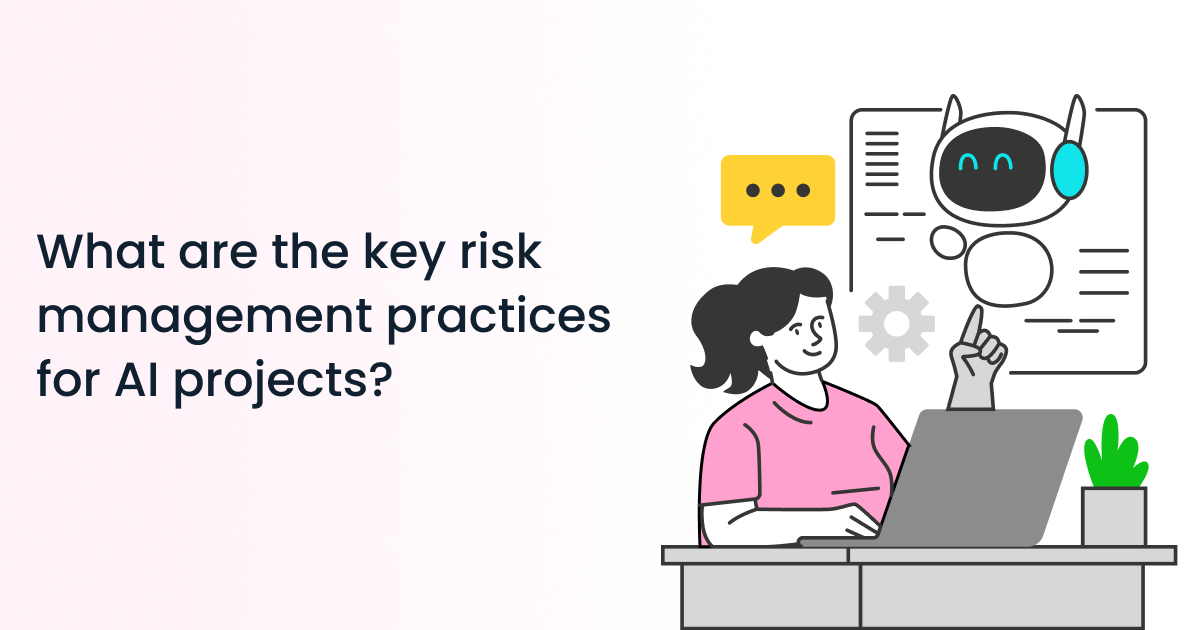
AI projects come with a distinct set of risks that differ from traditional software development. These risks span data integrity, model behavior, compliance, intellectual property ownership, and security vulnerabilities. Because AI systems learn from data and evolve over time, businesses must adopt structured AI project risk management frameworks that keep technical, legal, and operational risks under control.
The goal is not to eliminate every risk. Instead, it is to identify, evaluate, and reduce threats early, ensuring the project stays aligned with business goals, legal expectations, and performance benchmarks. Companies that implement proper risk practices experience fewer development delays, avoid regulatory issues, and maintain stronger control over their AI assets. With emerging standards, increasing automation, and growing liability expectations, risk management has become a core requirement for any AI initiative.

How do contracts and SLAs mitigate AI project risks?
Contracts and service level agreements are some of the strongest tools for risk mitigation. They clearly define responsibilities, expectations, performance guarantees, and ownership boundaries. AI development often involves multiple parties such as freelancers, agencies, cloud vendors, and in-house teams. Without strong SLAs, small misunderstandings can escalate into costly delays or compliance violations.
A contract should always define the scope of work, deliverables, model quality expectations, data handling rules, and responsibility boundaries. It must also state what happens if performance standards are not met. Strong AI project contracts for SLAs ensure both parties have aligned expectations from day one.
Common SLA elements include:
- Delivery timelines
- Model accuracy or performance thresholds
- Uptime and reliability commitments
- Data handling and retention rules
- Penalties or escalation steps when requirements are not met
AI introduces additional complexities, so agreements must reflect the dynamic nature of machine learning systems. Clear contractual language prevents disputes and provides a legal foundation that protects both clients and developers throughout the project lifecycle.
What AI specific clauses protect IP and data privacy?
AI contracts need specialized clauses to safeguard intellectual property, protect sensitive information, and maintain compliance with privacy laws. These requirements go beyond basic copyright rules. AI systems often include datasets, proprietary algorithms, learned model weights, and generated outputs. Clear definitions are necessary to avoid confusion or ownership disputes later.
Strong AI IP protection clauses typically address ownership of source code, rights to model outputs, licensing terms, and whether the developer can reuse components in future projects. Businesses must ensure that training data, model architectures, prompts, and feature engineering strategies remain confidential unless explicitly permitted for reuse. These clauses also help prevent unauthorized redistribution of proprietary assets.
Data privacy clauses must specify how sensitive information is processed, stored, shared, and cleaned. Strong data privacy AI contracts include confidentiality requirements, data access restrictions, anonymization rules, retention limits, encryption expectations, and compliance with laws such as GDPR, CCPA, or sector specific standards like HIPAA or PCI DSS. Without these provisions, companies risk data misuse, security vulnerabilities, and regulatory penalties.
How do pre-vetted marketplaces reduce legal risks?
Working with prescreened experts reduces legal and operational risks significantly. Many problems arise not because companies lack legal documents but because they hire talent who cannot interpret requirements, follow compliance rules, or properly document their work. Pre-vetted marketplaces ensure that experts are already trained to handle contract expectations, IP sensitivity, and structured workflows.
Platforms specializing in AI talent often verify skills, prior work quality, experience levels, and familiarity with legal constraints before onboarding developers. This reduces risks related to code quality, data misuse, or misunderstanding of regulatory obligations. These marketplaces also maintain their own compliance framework, which adds an additional layer of protection for clients.
Another advantage is that pre-vetted experts know how to follow structured development practices. They maintain documentation, version control, reproducibility, and model governance habits that support risk reduction. When contractors already understand these practices, the entire project proceeds with fewer disputes, fewer revisions, and reduced oversight demands from the client.
Working with pre-vetted professionals is one of the simplest ways to reduce risk because it eliminates uncertainty around capability, communication, and ethical standards.
What steps ensure AI project success and compliance?
To manage risks effectively, businesses must follow a structured process that keeps development aligned with technical accuracy, ethical expectations, and legal rules. Successful AI initiatives combine planning, documentation, validation, and monitoring. Regulatory expectations are expanding, and organizations cannot afford to treat compliance as an afterthought.
The most effective steps include:
1.Define the project scope clearly
A clear understanding of goals, success metrics, data quality, and technical constraints provides a strong foundation for risk control.
2.Assess datasets before development begins
Validate data sources, check labeling quality, and identify potential biases that could cause performance or compliance issues.
3.Implement model validation and testing
Evaluate outputs under different scenarios, log performance metrics, and test robustness across real world conditions.
4.Document every decision made
Documentation supports explainability, regulatory audits, debugging, and future development cycles.
5.Monitor the model continuously after deployment
AI systems degrade over time, so tracking drift, anomalies, and accuracy changes help maintain reliability.
6.Ensure alignment with legal and ethical standards
Follow privacy rules, maintain transparency, and enforce safe data handling practices throughout the project.
7.Review every milestone with stakeholders
Regular communication helps teams detect issues early before they escalate into costly failures.
When these steps are built into the project workflow, risk management becomes a natural process rather than a reactive measure. This approach keeps the development cycle smoother and more predictable, especially when working with external AI vendors or freelance specialists.

Conclusion
Effective AI project risk management depends on clear contracts, strong SLAs, defined IP protections, and reliable data security practices. By outlining expectations upfront, documenting responsibilities, and ensuring compliance with privacy laws, organizations can avoid delays, disputes, and regulatory challenges. Working with pre-vetted experts provides an additional safety layer by ensuring that AI professionals follow ethical, technical, and operational standards. With structured risk practices in place, businesses can confidently develop and deploy AI solutions that perform reliably and meet all compliance requirements.
FAQs
reducing financial exposure for organizations.
Author
Ravikumar Sreedharan

CEO & Co-Founder, Expertshub.ai
Ravikumar Sreedharan is the Co-Founder of ExpertsHub.ai, where he is building a global platform that uses advanced AI to connect businesses with top-tier AI consultants through smart matching, instant interviews, and seamless collaboration. Also the CEO of LedgeSure Consulting, he brings deep expertise in digital transformation, data, analytics, AI solutions, and cloud technologies. A graduate of NIT Calicut, Ravi combines his strategic vision and hands-on SaaS experience to help organizations accelerate their AI journeys and scale with confidence.
Latest Post

AI Freelance Rates in 2026: How Much AI Freelancers Earn
AI Freelancing Trends in 2026: How AI Is Changing Freelancing