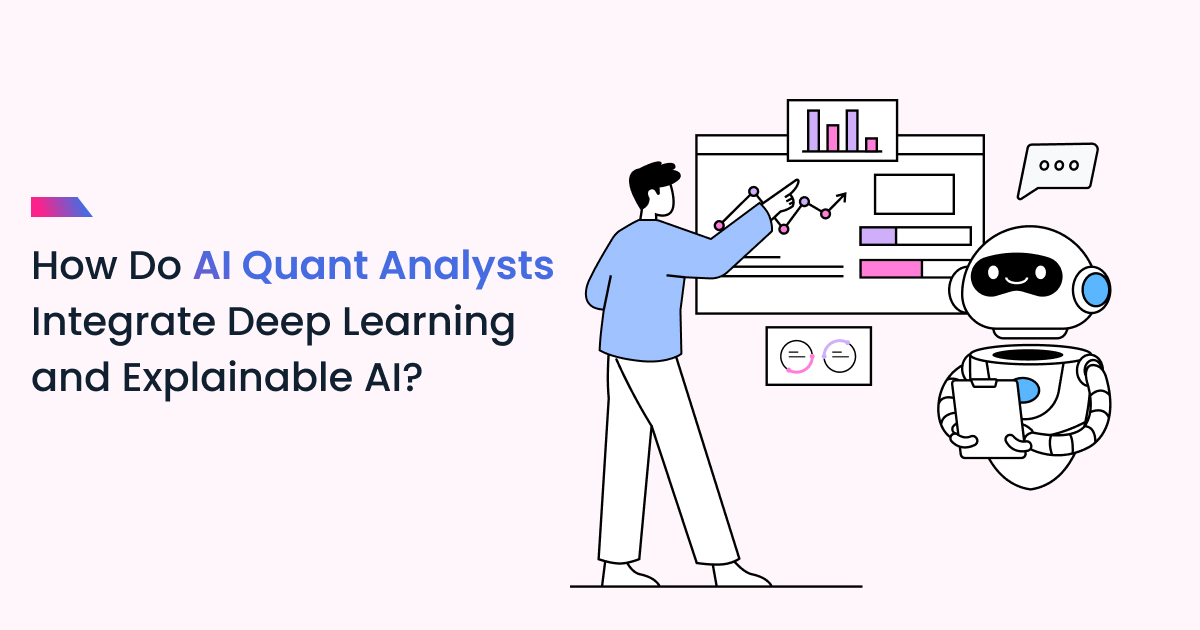
How Do AI Quant Analysts Integrate Deep Learning and Explainable AI?

The financial industry is increasingly relying on advanced AI techniques to process massive datasets, predict market trends, and optimize investment strategies. AI quant deep learning allows quantitative analysts to uncover patterns and insights that traditional models often miss. By leveraging neural networks, reinforcement learning, and other deep learning approaches, quants can develop models that forecast market movements, assess portfolio risks, and identify arbitrage opportunities with high accuracy.
Deep learning models excel at handling large volumes of structured and unstructured data, such as stock prices, financial news, and social media sentiment. For deep learning quantitative analysts, these capabilities translate into more precise predictions and better-informed investment decisions. The integration of deep learning in quantitative finance is not only enhancing profitability but also improving risk management and operational efficiency across institutions.

While deep learning provides high accuracy, its complexity often makes models difficult to interpret. This is where explainable AI finance comes into play. Explainable AI, or XAI, allows analysts, regulators, and stakeholders to understand how AI models make decisions, providing transparency in otherwise opaque systems.
For financial institutions, transparency is critical. Stakeholders need to trust AI-generated recommendations, whether for trading, credit scoring, or portfolio management. XAI quant finance ensures that decision-making processes are interpretable, reducing the risk of unexpected model behavior and enhancing accountability.
Compliance with financial regulations is non-negotiable. AI systems that are opaque may fail audits or trigger regulatory scrutiny. By using AI quant model interpretability tools, institutions can provide clear documentation of model logic, assumptions, and decision pathways.
XAI enables quant analysts to demonstrate that models comply with regulations such as Basel III, MiFID II, and anti-money laundering rules. Transparent models help regulators understand decision processes, mitigate legal risk, and maintain investor confidence. Furthermore, XAI facilitates internal reviews and validation of AI strategies, ensuring that risk management frameworks are robust and defensible.
Quantitative analysts leverage a variety of deep learning architectures depending on the task. Common models include:
By combining deep learning with AI quant deep learning expertise, analysts can create sophisticated models that improve predictive accuracy, optimize portfolios, and detect anomalies. Integrating explainability into these models ensures that complex algorithms remain transparent and actionable for both technical and non-technical stakeholders.
Finding professionals proficient in both deep learning and XAI requires targeted recruitment strategies. Companies should prioritize candidates who demonstrate experience with neural network architectures, financial modeling, and AI interpretability frameworks.
Key strategies include:
By focusing on these approaches, firms can secure deep learning quantitative analysts capable of building high-performing, transparent, and regulatory-compliant AI models. Such talent ensures that organizations not only gain predictive power but also maintain trust, transparency, and alignment with regulatory expectations.
AI quant deep learning and explainable AI finance are transforming how quantitative analysts operate. By combining predictive power with transparency, AI quants can deliver actionable insights while ensuring regulatory compliance. Leveraging sophisticated deep learning models alongside XAI frameworks allows financial institutions to optimize investments, manage risk, and build trust with stakeholders. Hiring professionals skilled in both deep learning and XAI ensures that AI initiatives are not only effective but also interpretable and accountable.

Author

CEO & Co-Founder, Expertshub.ai
Ravikumar Sreedharan is the Co-Founder of ExpertsHub.ai, where he is building a global platform that uses advanced AI to connect businesses with top-tier AI consultants through smart matching, instant interviews, and seamless collaboration. Also the CEO of LedgeSure Consulting, he brings deep expertise in digital transformation, data, analytics, AI solutions, and cloud technologies. A graduate of NIT Calicut, Ravi combines his strategic vision and hands-on SaaS experience to help organizations accelerate their AI journeys and scale with confidence.