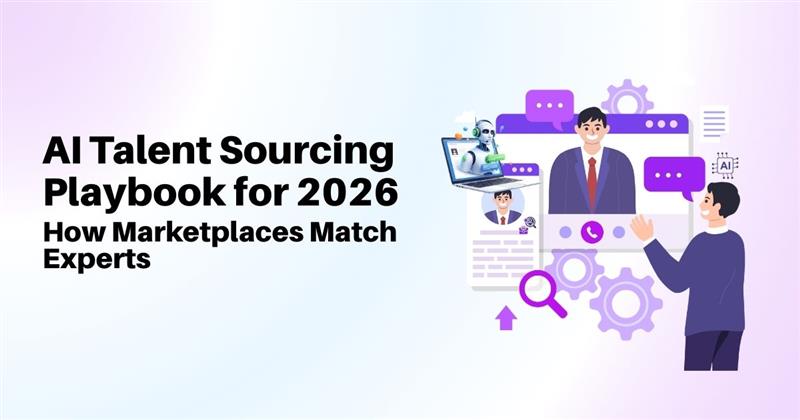
AI Talent Sourcing Playbook for 2026 (How to Hire Top AI Talent Faster)


What is AI Talent Sourcing and & Why It Matters in 2026?
AI talent sourcing is the process of identifying, evaluating, and hiring AI professionals based on real skills, domain expertise, and project fit rather than resumes alone. It is different today because AI roles are highly specialized, making traditional hiring methods slow, inaccurate, and inefficient.
As demand for AI engineers, MLOps specialists, and GenAI experts grows, companies need smarter, faster ways to source talent that can actually deliver.
Why Traditional Sourcing Fails for AI Roles
Why does traditional hiring struggle with AI talent sourcing?
Traditional sourcing fails because it relies on resumes, generic job descriptions, and manual screening, which do not accurately reflect real AI capabilities. AI roles are too nuanced, and surface-level evaluation leads to mismatches.
Here’s where it breaks:
- Job titles are inconsistent
- A “machine learning engineer” can mean very different skill sets
- Resumes lack depth
Listing tools is not the same as deploying production systems
4. Recruiters lack technical filtering
- Specialized AI roles require domain understanding
5. High competition for talent
- Top AI professionals rarely apply through job boards
According to the World Economic Forum’s Future of Jobs Report 2023, AI and machine learning specialists are among the fastest-growing roles globally. This demand makes inefficient sourcing even more costly.
How AI Talent Marketplaces Use Tests and Data for Sourcing
How do AI talent marketplaces improve AI talent sourcing?
AI talent marketplaces improve sourcing by using structured assessments, real-world tests, and data-driven matching instead of resume screening. This ensures that only capable candidates are shortlisted.
The process typically works like this:
1. Role mapping
- Business requirements are translated into precise skill needs
2. Candidate evaluation
- Developers go through coding tests, scenario-based assessments, and AI-driven interviews
3. Data-based ranking
- Candidates are scored based on performance, experience, and role fit
4. Curated shortlists
- Companies receive a small set of highly relevant candidates
Platforms like expertshub.ai follow this approach to help companies find pre-vetted AI professionals aligned with industry needs, reducing hiring time and improving accuracy.

Signals That Predict Success in AI Projects
What signals actually predict whether an AI hire will succeed?
Successful AI talent sourcing depends on identifying signals that go beyond resumes and certifications.
Key predictive signals include:
- Production experience
Has the candidate deployed models in real-world systems?
- Problem-solving ability
Can they translate business problems into AI solutions?
- Domain expertise
Experience in industries like fintech, healthcare, or retail adds significant value
- Collaboration skills
Ability to work in distributed ML teams and communicate clearly
- Ownership mindset
Willingness to take responsibility for outcomes, not just tasks
Here’s a simple comparison:
| Weak Signal | Strong Signal |
| Tool familiarity | Production deployment experience |
| Certifications | Real-world project outcomes |
| Resume keywords | Measurable impact and results |
Platforms like expertshub.ai incorporate these signals into their evaluation process, helping companies hire talent that performs, not just interviews well.
How to Brief a Marketplace for Better Shortlists
How can you get better results from AI talent sourcing platforms?
The quality of your shortlist depends heavily on how clearly you define your requirement.
Follow this structure:
1. Start with the use case
- Define the problem you are solving, not just the role
2. Specify required outcomes
- Example: improve model accuracy, reduce latency, or build a chatbot
3. Define technical scope
- Mention tools, frameworks, and infrastructure preferences
4. Clarify seniority level
- Distinguish between execution-focused and architecture-level roles
5. Set constraints
- Budget, timeline, and compliance requirements
When companies approach platforms like expertshub.ai with structured briefs, they receive fewer but more relevant candidates, accelerating decision-making.

Key Takeaways
- AI talent sourcing requires a shift from resumes to skill-based evaluation
- Traditional hiring fails due to lack of depth and slow processes
- AI marketplaces use tests and data to improve match accuracy
- Strong signals like production experience predict success better than credentials
- Platforms like expertshub.ai help companies hire faster with pre-vetted AI talent
AI talent sourcing in 2026 is about precision. The companies that win are not the ones reviewing the most profiles, but the ones making the right hires quickly.
Frequently Asked Questions
AI talent sourcing is difficult due to:
- Highly specialized roles
- Lack of standardized job titles
- High competition for top talent
- Difficulty in evaluating real-world AI skills
expertshub.ai, companies can shortlist candidates within 48–72 hours.
Author
Ravikumar Sreedharan

CEO & Co-Founder, Expertshub.ai
Ravikumar Sreedharan is the Co-Founder of ExpertsHub.ai, where he is building a global platform that uses advanced AI to connect businesses with top-tier AI consultants through smart matching, instant interviews, and seamless collaboration. Also the CEO of LedgeSure Consulting, he brings deep expertise in digital transformation, data, analytics, AI solutions, and cloud technologies. A graduate of NIT Calicut, Ravi combines his strategic vision and hands-on SaaS experience to help organizations accelerate their AI journeys and scale with confidence.
Latest Post
AI Talent Sourcing Playbook for 2026 (How to Hire Top AI Talent Faster)
How to Hire an AI Model Fine-Tuning Specialist for Your Project