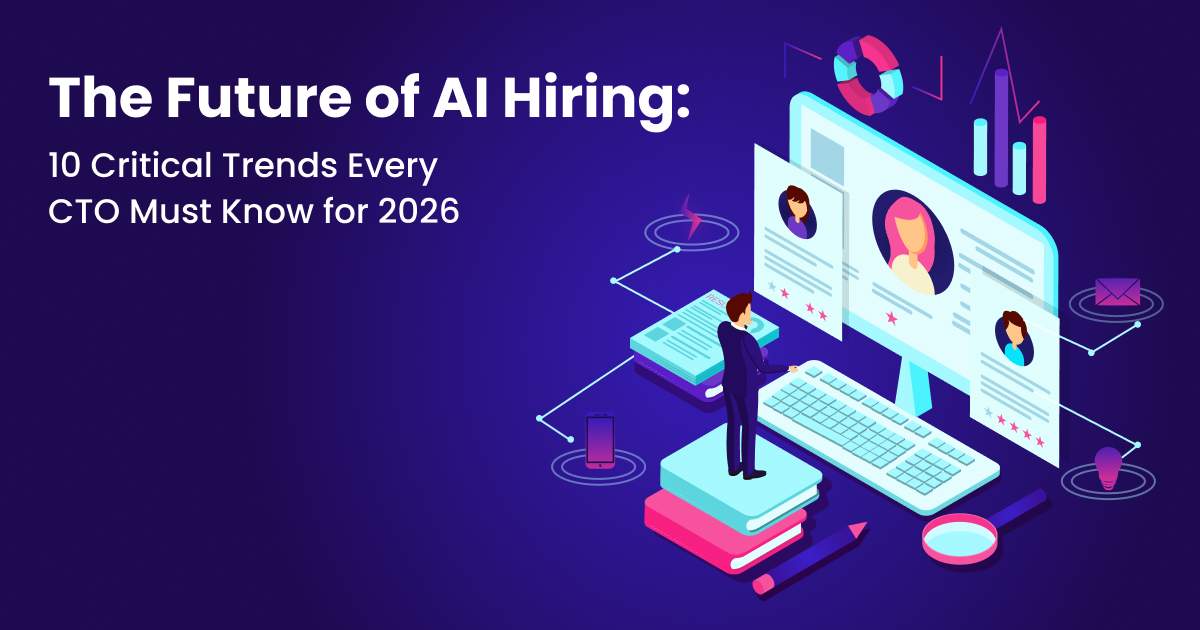
The Future of AI Hiring: 10 Critical Trends Every CTO Must Know for 2026


As artificial intelligence continues to redefine industries, the demand for AI talent is skyrocketing. For CTOs, 2026 is shaping up to be a pivotal year for AI recruitment strategy. Organizations that fail to adapt to the evolving landscape risk falling behind in innovation, competitiveness, and market relevance. Understanding the AI hiring trends 2026 and anticipating the future of AI recruitment is critical to building resilient, high-performing teams.
This article explores the key trends that every CTO should consider when planning their AI talent strategy, from emerging roles to shifting compensation patterns, and from evolving hiring practices to the technologies reshaping recruitment.

Why 2026 Is the Make-or-Break Year for AI Talent Strategy
2026 is critical because the demand for AI talent is outpacing supply. Companies that fail to adapt risk delays in product launches and under-optimized AI systems. The AI landscape is expanding at an unprecedented pace. Large language models, generative AI, reinforcement learning systems, and AI-driven automation tools are no longer experimental technologies. CTOs need to anticipate AI talent trends and prepare their teams for specialized, highly technical, and cross-functional roles. This includes redefining recruitment practices, offering attractive compensation structures, and investing in continuous learning opportunities.
What Major Shifts Are Happening in AI Talent Demand?
AI talent demand is moving towards specialization and domain expertise. Generalists are becoming less valuable in highly technical industries. AI development is moving beyond experimentation into production. Specialized roles such as MLOps engineers, AI safety experts, and AI systems reliability engineers are in high demand.
While generalists have been valuable in early-stage development, organizations now prioritize candidates who combine technical skills with industry-specific knowledge. Roles like AI product managers are also gaining importance, bridging the gap between technical teams and business goals. Additionally, soft skills for AI-human collaboration are increasingly essential as AI systems become integrated into team workflows.
Rise of Specialized AI Roles (MLOps, AI Safety, etc.)
Specialized AI roles focus on scalability, reliability, and ethical operation of AI models. MLOps engineers, AI safety experts, and reliability engineers ensure AI systems function efficiently and responsibly. CTOs should prioritize these roles when designing recruitment strategies.
Shift from Generalists to Domain Specialists
Industry-specific expertise is now a key differentiator. Healthcare, finance, and manufacturing organizations require AI professionals with knowledge of sector-specific regulations, datasets, and business contexts. This shift ensures AI solutions are effective and relevant.
Increased Focus on AI Product Management
AI product managers bridge technical and business needs. They ensure AI initiatives align with organizational strategy, deliver measurable results, and integrate seamlessly into product roadmaps.
Growing Need for AI-Human Collaboration Skills
Communication and collaboration skills are essential alongside technical expertise. AI professionals must work effectively with cross-functional teams, interpret AI outputs, and support decision-making processes.
How Are AI Hiring Practices Evolving?
AI hiring is increasingly skill-driven rather than degree-focused. Traditional hiring practices are being replaced with real-world assessments and continuous learning evaluation. Companies are focusing on candidates’ demonstrable abilities. Online coding tests, project simulations, and portfolio reviews are common. Remote-first team structures are now standard, and organizations emphasize adaptability, collaboration, and ongoing learning capabilities to keep pace with AI advancements.
Skills-Based Assessment Over Degree Requirements
Technical ability is valued over formal education. Employers use coding tests, AI challenges, and open-source contributions to evaluate practical skills.
Real-World Project Evaluation Methods
Candidates are assessed on problem-solving in realistic scenarios. Simulated projects provide insight into coding proficiency, model design, and application of AI in production environments.
Remote-First AI Team Building
Global talent pools are becoming standard. Distributed teams require flexibility, asynchronous communication, and effective project management strategies to succeed.
Continuous Learning Capability Assessment
Adaptability is essential in fast-moving AI domains. Employers evaluate candidates’ commitment to growth through certifications, workshops, research contributions, and active skill development.
What New AI Roles Are Emerging?
New AI roles are emerging to meet increasing technical, ethical, and operational demands. CTOs must recognize the importance of roles such as AI safety engineers, prompt engineers, AI ethics officers, and AIOps engineers. These positions address model reliability, ethical compliance, operational efficiency, and the growing complexity of AI deployments.
AI Safety Engineers
They ensure AI systems operate safely and reliably. Safety engineers implement safeguards, monitor models, and align AI systems with organizational risk frameworks.
Prompt Engineers and LLM Specialists
These professionals optimize interactions with large language models. They ensure LLMs produce accurate, efficient, and creative results for diverse applications.
AI Ethics Officers
They enforce ethical AI practices across organizations. Ethics officers monitor fairness, transparency, and bias, ensuring compliance with internal and external standards.
AI Operations (AIOps) Engineers
AIOps engineers manage AI systems in production. They bridge development and operations, ensuring smooth deployment, monitoring, and maintenance of AI workflows.
How Is Compensation Changing for AI Roles?
AI compensation is evolving to include equity, performance-based incentives, and non-traditional benefits. Companies are balancing competitive salaries with long-term incentives, geographic arbitrage, and benefits that appeal to top-tier talent. Compensation structures are increasingly tailored to retain specialized AI professionals while rewarding measurable contributions.
Equity vs Salary Balance Shifts
Equity is becoming a critical part of compensation. Startups and tech firms use equity alongside salaries to incentivize long-term commitment and align individual and organizational goals.
Performance-Based AI Compensation
Rewarding measurable results is key. Bonuses and incentives are tied to project outcomes, AI model performance, and business impact.
Geographic Salary Arbitrage Trends
Remote hiring allows cost optimization without sacrificing talent quality. Organizations offer competitive pay relative to local markets while accessing global AI expertise.
Benefits Beyond Traditional Packages
Flexible schedules, wellness programs, and professional development are now essential. Modern AI professionals expect comprehensive packages that enhance work-life balance and career growth opportunities.
What Technologies Are Reshaping AI Hiring?
Recruitment technology is enhancing efficiency, reducing bias, and improving candidate evaluation. AI-powered assessment, virtual reality interviews, blockchain credential verification, and automated reference checking streamline hiring and ensure the right talent is selected.
AI-Powered Candidate Assessment
AI tools analyze resumes, portfolios, and coding tasks. They help identify high-potential candidates and reduce bias during screening.
Virtual Reality for Technical Interviews
VR provides immersive interview experiences. Candidates solve complex problems in simulated environments, allowing deeper evaluation of skills and collaboration.
Blockchain for Credential Verification
Blockchain ensures secure, verifiable academic and professional records. It accelerates background checks and prevents fraudulent claims for specialized AI roles.
Automated Reference Checking
Automated systems streamline verification processes. AI and machine learning tools provide faster and more reliable insights into candidate backgrounds.
How Should CTOs Prepare for These Changes?
CTOs should focus on building diverse, adaptable teams and investing in continuous learning. Strategic pipeline development, proactive engagement with top talent, and a focus on skills and specialization will be essential to succeed in 2026. Preparing now ensures organizations can implement AI safely, efficiently, and competitively.
Building Future-Ready AI Teams
Combine specialists, generalists, and product managers for high-performing teams. Teams should include AI-human collaboration experts and technical specialists to address both innovation and operational efficiency.
Investment in Continuous Learning
Upskilling programs are essential to maintain expertise. Certifications, workshops, and knowledge-sharing platforms ensure AI teams stay current with emerging technologies.
Strategic Talent Pipeline Development
Proactive talent engagement is critical. Building relationships with universities, participating in AI communities, and maintaining connections with passive candidates ensures organizations can respond swiftly to talent demands.

Conclusion
The future of AI recruitment is here. Companies that anticipate AI hiring trends 2026 and prepare for emerging roles, evolving compensation, and innovative hiring practices will maintain a strategic advantage. For CTOs, 2026 is the year to rethink AI hiring strategies, invest in continuous learning, and build teams capable of driving innovation, growth, and ethical AI development. By taking proactive measures today, organizations can secure the talent necessary to navigate the fast-paced world of AI and remain competitive in the years ahead.
Frequently Asked Questions
Author
Ravikumar Sreedharan

CEO & Co-Founder, Expertshub.ai
Ravikumar Sreedharan is the Co-Founder of ExpertsHub.ai, where he is building a global platform that uses advanced AI to connect businesses with top-tier AI consultants through smart matching, instant interviews, and seamless collaboration. Also the CEO of LedgeSure Consulting, he brings deep expertise in digital transformation, data, analytics, AI solutions, and cloud technologies. A graduate of NIT Calicut, Ravi combines his strategic vision and hands-on SaaS experience to help organizations accelerate their AI journeys and scale with confidence.
Latest Post

How to Become an AI Freelancer in 2026
Best AI Skills for Freelancers in 2026 (High-Demand & High-Paying)