Building a Computer Vision Team: Skills, Roles, and Best Practices


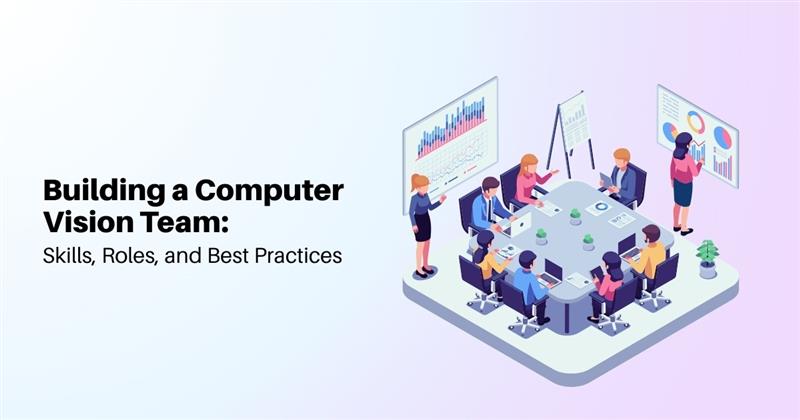
Introduction: The Strategic Value of Computer Vision
A well-built computer vision team can turn raw images and video into measurable business value. Whether you are automating quality inspection in manufacturing, enabling real-time facial authentication in fintech, or improving diagnostics in healthcare, visual AI is no longer experimental. It is operational infrastructure.
The global computer vision market continues to expand rapidly as industries adopt automation and AI-powered analytics. Grand View Research projects strong long-term growth driven by demand across retail, automotive, healthcare, and security sectors.
This growth means companies are no longer asking whether they need computer vision capabilities. They are asking how to build the right team without wasting time or budget. That starts with understanding the roles required and how they work together.
If your organization is defining its visual AI roadmap, platforms like expertshub.ai can help translate business objectives into specific hiring requirements, matching companies with vetted image recognition developers and visual AI experts globally.
Essential Roles in a High-Performing Computer Vision Team
A strong computer vision team is not just a group of model builders. It is a coordinated unit that moves from data collection to deployment and optimization.
At the core, you need computer vision engineers who design and train models for classification, detection, segmentation, or tracking. These engineers are responsible for selecting architectures, evaluating model performance, and iterating based on real-world constraints. Closely aligned with them are machine learning engineers who structure pipelines, manage experiments, and ensure reproducibility.
Image recognition developers often specialize further. They focus on production-grade implementations such as facial recognition systems, OCR engines, retail shelf analytics, or defect detection tools. Their strength lies in integrating models into usable systems.
As projects scale, additional roles become essential. Data engineers manage ingestion pipelines and storage. MLOps engineers ensure deployment stability and performance monitoring. Visual AI experts with domain knowledge provide context, especially in regulated sectors such as healthcare or financial services.
Leadership functions anchor the team. An AI architect defines system structure and scalability. A product manager ensures the computer vision team is solving the right business problems, not just improving model metrics.
When companies skip clear role definition, experimentation increases but deployment slows. Clarity in responsibility is what turns research into results.

Required Skills and Expertise for Computer Vision Teams
Hiring for a computer vision team requires evaluating depth, not just familiarity.
Algorithmic strength is fundamental. Engineers should be comfortable with convolutional neural networks, vision transformers, object detection frameworks, and segmentation models. They must understand performance metrics beyond accuracy, including precision, recall, IoU, and inference latency.
Equally important is data maturity. Visual AI depends heavily on dataset quality. Teams must understand preprocessing pipelines, augmentation strategies, labeling consistency, and bias detection. In many cases, improvements in annotation quality produce greater gains than architecture changes.
Deployment knowledge is what separates strong teams from academic groups. Your computer vision team should understand GPU optimization, containerization, real-time inference constraints, and monitoring strategies for model drift. Production systems demand resilience.
If you are unsure how to assess these capabilities internally, expertshub.ai provides structured technical evaluations designed specifically for AI roles, helping organizations validate both modeling strength and deployment readiness before hiring.
Computer Vision Team Structure and Organization Models
The structure of a computer vision team should reflect the stage of your product.
In early stages, a lean model works best. A senior computer vision engineer, one ML engineer, and shared DevOps support can move quickly from prototype to proof of concept. The focus here is experimentation and validation.
As user adoption grows, specialization becomes necessary. Dedicated MLOps support ensures stable deployment. Data engineers maintain scalable pipelines. Annotation teams improve dataset quality. The structure evolves from generalists to a mix of specialists.
At enterprise scale, teams often split into pods aligned by use case. For example, one pod may focus on inspection automation while another handles video analytics. Each pod retains modeling, data, and deployment capabilities within it.
Scaling prematurely creates overhead. Scaling too late creates bottlenecks. The right balance depends on workload predictability and compliance requirements.
Collaboration Tools and Workflows for Computer Vision Development
Computer vision projects generate heavy data and complex experiments. Without structured workflows, iteration slows dramatically.
Successful teams use version control rigorously. They track experiments systematically. They document architecture decisions. They implement CI/CD pipelines that allow models to move from development to production smoothly.
Cloud-based GPU environments are common for training at scale. Monitoring systems track inference performance and detect degradation. Security protocols protect sensitive image data.
Strong workflows reduce rework and make team performance measurable.

Case Studies: Successful Enterprise Computer Vision Teams
High-performing computer vision teams share predictable characteristics.
Manufacturing teams that prioritize dataset refinement before chasing architectural complexity often achieve faster defect detection improvements. Healthcare imaging teams that integrate regulatory oversight early avoid costly revalidation later. Retail analytics teams that embed domain experts alongside engineers reduce iteration cycles significantly.
The common pattern is structured execution. Teams that clearly define roles, prioritize deployment readiness, and align closely with business objectives outperform loosely organized research groups.
Organizations that leverage platforms like expertshub.ai often move faster because they access pre-vetted visual AI experts and image recognition developers who already have production experience, reducing ramp-up time.
Frequently Asked Questions
Author
Ravikumar Sreedharan

CEO & Co-Founder, Expertshub.ai
Ravikumar Sreedharan is the Co-Founder of ExpertsHub.ai, where he is building a global platform that uses advanced AI to connect businesses with top-tier AI consultants through smart matching, instant interviews, and seamless collaboration. Also the CEO of LedgeSure Consulting, he brings deep expertise in digital transformation, data, analytics, AI solutions, and cloud technologies. A graduate of NIT Calicut, Ravi combines his strategic vision and hands-on SaaS experience to help organizations accelerate their AI journeys and scale with confidence.
Latest Post

AI Freelance Rates in 2026: How Much AI Freelancers Earn
AI Freelancing Trends in 2026: How AI Is Changing Freelancing