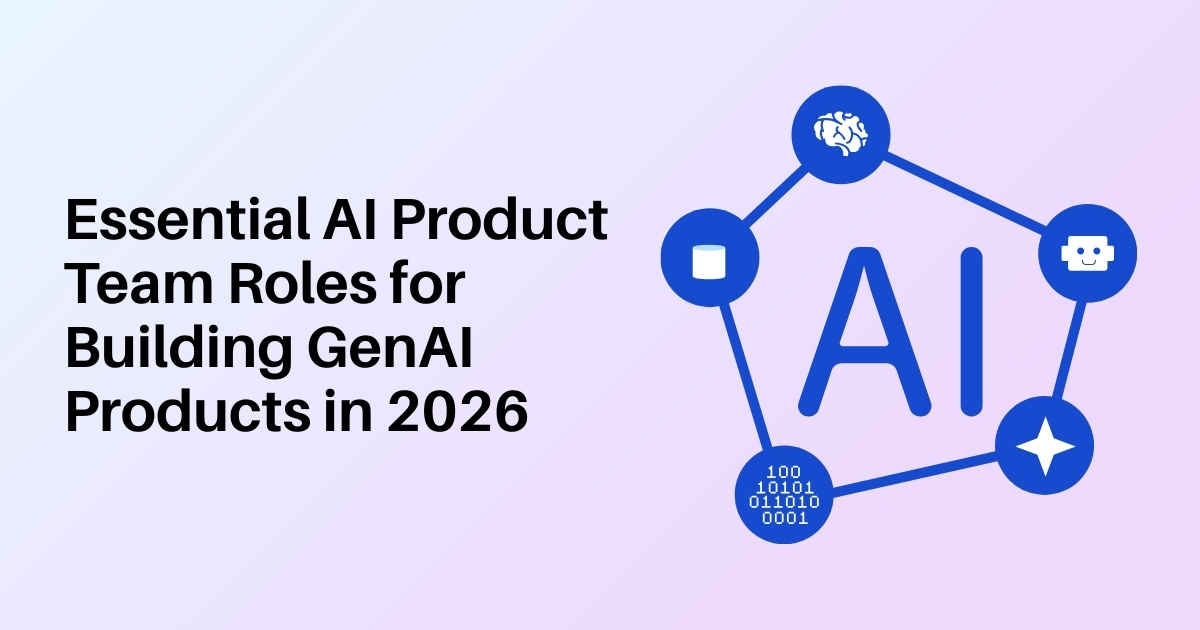
Essential AI Product Team Roles for Building GenAI Products in 2026


If you are building a generative AI product, your technology stack is only half the equation. The other half is your team structure. Most AI products do not fail because the model is weak. They fail because the AI product team roles were unclear, incomplete, or poorly aligned.
In 2026, building GenAI products requires more than hiring “an AI engineer.” It demands a structured team that can move from experimentation to scalable delivery.
This guide breaks down the essential AI product team roles you need and how to structure them for end-to-end execution.
Why AI products fail without the right team structure
Many companies start with one strong ML engineer and assume progress will compound. Instead, bottlenecks multiply.
Without defined AI product team roles, responsibilities blur. Models get built but never deployed properly. Infrastructure struggles under real user traffic. Prompt engineering experiments stay disconnected from product workflows. Compliance and safety are treated as afterthoughts.
AI systems are different from traditional software systems. They evolve continuously. They depend on data quality, monitoring, retraining cycles, and governance. Without a structured team, these moving parts create friction.
Clear team structure reduces chaos. It aligns product strategy, engineering execution, infrastructure stability, and risk management.
Platforms like expertshub.ai help companies define their AI strategy first, then identify the exact roles needed to execute it. That clarity prevents misaligned hiring and speeds up delivery.
Which AI roles are core for GenAI product development?
Core AI product team roles for GenAI products typically include:
- An AI Architect who defines system design, model choices, and scalability strategy.
- Machine Learning Engineers who build and fine-tune models.
- MLOps Engineers who deploy, monitor, and scale models reliably.
- Data Engineers who manage pipelines, feature stores, and data integrity.
- Frontend or Full-Stack Engineers who integrate AI outputs into user experiences.
- Prompt Engineersor Applied AI Engineers who optimize model performance in real use cases.
As GenAI adoption grows, roles around evaluation, guardrails, and human-in-the-loop feedback are becoming critical.

The U.S. Bureau of Labor Statistics projects employment in computer and information research roles to grow 23 percent from 2022 to 2032, much faster than average
This growth reflects rising demand for specialized AI expertise.
If you are unsure how to structure these roles, expertshub.ai helps define AI product team roles aligned with your industry and product maturity, ensuring you hire skills that match execution needs.
How should you balance generalists vs specialists?
Early teams often rely on generalists. This works at MVP stage. One engineer may handle modeling, deployment, and backend integration.
However, as complexity grows, specialists become necessary. GenAI systems involve prompt optimization, inference cost control, safety filtering, and distributed infrastructure. These require deep expertise.
The right balance depends on product stage. In early experimentation, generalists move faster. In scaling phases, specialists prevent technical debt.
The mistake many founders make is scaling headcount before clarifying role boundaries. Instead, define outcomes first. Then align AI product team roles around those outcomes.
Through expertshub.ai, companies can map strategy to role definition and hire globally across specialized AI domains without overbuilding internal teams.
Ideal team ratios for early-stage GenAI products
For early-stage GenAI products, lean structures are effective.
A common ratio might include one AI architect or senior ML engineer, one applied AI or prompt engineer, one backend or full-stack engineer, and shared DevOps or MLOps support.
As user adoption increases, infrastructure and monitoring needs grow. At that stage, adding dedicated MLOps engineers becomes critical. Data engineering support becomes essential if data pipelines expand.
The key is not rigid ratios but functional coverage. Every GenAI product needs ownership across modeling, infrastructure, integration, and governance.
expertshub.ai enables companies to scale AI product team roles flexibly, hiring cross-border talent based on evolving workload rather than committing prematurely to fixed internal structures.
When to add AI product managers and AI safety experts?
AI product managers become essential once your product interacts with real customers and revenue. They bridge technical execution with user needs, roadmap prioritization, and ethical considerations.
AI safety experts become critical when your product generates user-facing content, handles sensitive data, or operates in regulated industries. Generative AI introduces risks around hallucinations, bias, misinformation, and compliance.
As regulatory attention increases globally, structured oversight is no longer optional. AI governance must be embedded into team design.
Adding these roles early reduces rework later. It also strengthens investor confidence and customer trust.
expertshub.ai supports companies in defining when to introduce AI product managers, AI safety experts, and governance specialists based on product maturity and industry requirements.
Also Read ? Collaboration Between AI Engineers and Product Managers in AI Product Development

Sample org charts for AI product teams by stage
At MVP stage, your AI product team roles may include a senior ML engineer leading modeling, one applied AI engineer, and one full-stack developer. Infrastructure may be shared.
At growth stage, you introduce dedicated MLOps, a data engineer, and possibly an AI product manager. Responsibilities become more segmented.
At scale stage, you expand into specialized AI domains such as LLM optimization, AI safety, performance engineering, and global infrastructure operations. Cross-functional coordination becomes structured, often with multiple product pods.
The transition between these stages should be deliberate. Scaling too slowly stalls growth. Scaling too quickly creates overhead.
expertshub.ai helps companies hire AI skills from anywhere in the world, define role clarity, ensure quality through AI-driven assessments, and manage distributed AI teams with structured task tracking and transparent pricing.
Frequently Asked Questions
Contractors and freelancers are valuable for specialized tasks such as LLM fine-tuning, infrastructure setup, security audits, or short-term experimentation. They allow flexibility without long-term overhead.
Platforms like expertshub.ai enable structured contractor engagement, cross-border hiring, standardized pricing, and secure payments across currencies. This makes it easier to integrate global AI talent into your product roadmap.
If you are building a GenAI product in 2026, your success will depend less on the model you choose and more on the AI product team roles you define. Structure drives execution. Execution drives outcomes.
Author
Ravikumar Sreedharan

CEO & Co-Founder, Expertshub.ai
Ravikumar Sreedharan is the Co-Founder of ExpertsHub.ai, where he is building a global platform that uses advanced AI to connect businesses with top-tier AI consultants through smart matching, instant interviews, and seamless collaboration. Also the CEO of LedgeSure Consulting, he brings deep expertise in digital transformation, data, analytics, AI solutions, and cloud technologies. A graduate of NIT Calicut, Ravi combines his strategic vision and hands-on SaaS experience to help organizations accelerate their AI journeys and scale with confidence.
Latest Post

AI Freelance Rates in 2026: How Much AI Freelancers Earn
AI Freelancing Trends in 2026: How AI Is Changing Freelancing