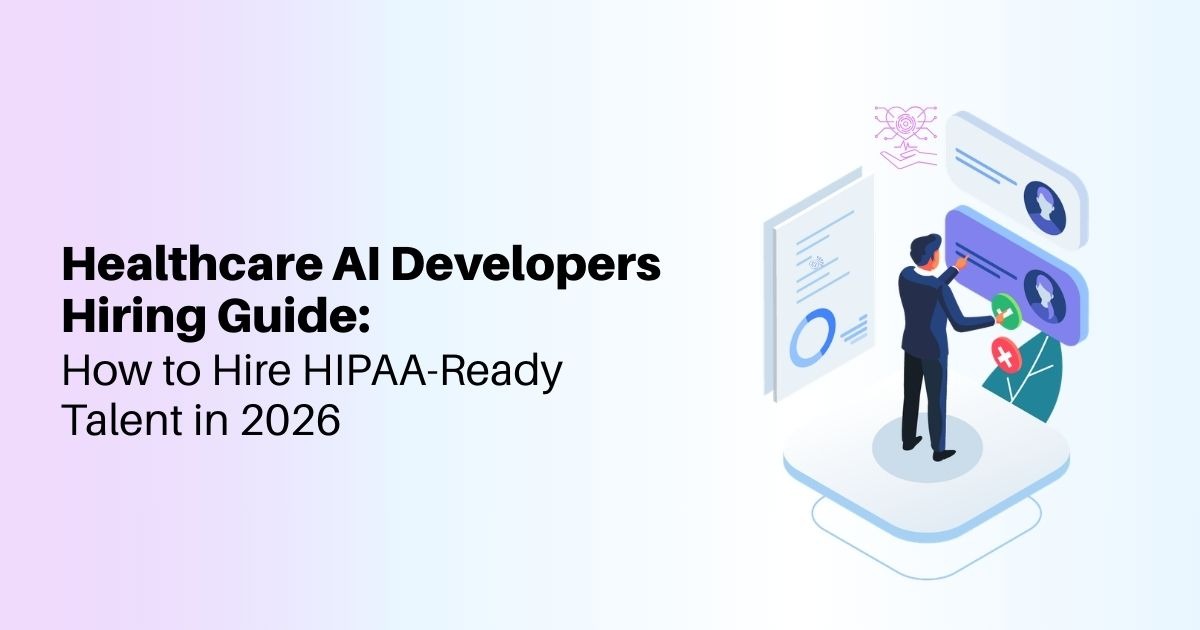
Healthcare AI Developers Hiring Guide: How to Hire HIPAA-Ready Talent in 2026


Hiring healthcare AI developers in 2026 is not just about finding someone who can train a model. It’s about hiring people who can work safely with sensitive medical data, build systems that hold up in audits, and ship AI into real clinical or operational workflows without creating privacy risk.
If you want your healthcare AI initiative to survive beyond pilots, your hiring process needs to be “HIPAA-ready” from day one.
Key AI Use Cases in Healthcare and Health Tech
Most teams hire healthcare AI developers for one of three outcomes: reduce clinician workload, improve decision support, or streamline operations.
GenAI is being adopted heavily for clinical documentation and administrative workflows, where the value comes from summarization, drafting, and patient communication support rather than replacing clinical judgment. McKinsey has highlighted GenAI’s potential across healthcare operations and stakeholder engagement, with many organizations moving toward full-scale implementation.
On the traditional ML side, common use cases include imaging assistance, risk stratification, readmission prediction, triage prioritization, claims automation, and fraud or waste detection. The thread across all of these is the same: data quality, traceability, and reliable deployment matter as much as model accuracy.
This is also where expertshub.ai fits naturally. If your use case is clear but the roles are not, expertshub.ai helps you define the AI strategy, translate it into the roles you actually need, and then hire globally from vetted talent pools.
Essential Skills Healthcare AI Developers Must Bring to Your Team
A strong healthcare AI developer should be solid in core ML engineering, but healthcare adds extra layers that many general AI profiles do not have.
You want competence in data pipelines and labeling realites (messy EHR data, mixed formats, missingness, shifting distributions). You also want production discipline: model versioning, reproducibility, monitoring, and rollback planning.
Healthcare also demands “explainability maturity.” Even if you are not building a regulated medical device, you still need interpretability practices, documentation habits, and comfort working with clinical stakeholders who will ask “why did the model say this?”
Finally, you need security awareness as a working skill, not a compliance checkbox. Encryption, access control, environment separation, secure logging, and least-privilege thinking should show up naturally in how they build.
expertshub.ai is useful here because it helps narrow the hiring target. Instead of “hire an AI developer,” you can define whether you need applied GenAI (RAG, evaluation, guardrails), clinical NLP, imaging ML, MLOps for regulated environments, or data engineering-heavy talent, then assess for those specifics.

How HIPAA Compliance Impacts AI Hiring Decisions
HIPAA changes hiring because it changes risk.
The HIPAA Privacy Rule sets limits and conditions on how protected health information can be used and disclosed, and requires appropriate safeguards.
The HIPAA Security Rule establishes standards to protect electronic protected health information (ePHI) and requires administrative, physical, and technical safeguards.
Practically, this means your hiring and vendor decisions need to account for who will access PHI, where the data will live, how access will be logged, and how risk analysis and risk management are handled. HHS also provides Security Rule guidance materials and highlights the importance of risk analysis requirements in practice.
This is where many teams make a costly mistake. They hire a great model builder, then later realize their workflows require stricter environment controls, better documentation, and contractual protections that were never set up.
If you are working with external talent, you typically need to treat them like part of your regulated delivery process. That can include a Business Associate Agreement when applicable and strict process controls around PHI access. I’m not offering legal advice here, but in healthcare AI, contract and security readiness is part of technical readiness.
Salary & Hourly Rates for Healthcare AI Developers in 2026
Compensation varies a lot by region, seniority, and whether you need healthcare-domain experience plus privacy-ready delivery.
For a concrete benchmark, Salary.com lists a U.S. Machine Learning Engineer average salary of $109,936 as of February 1, 2026, with a typical range of $101,183 to $119,288.
Startup healthcare compensation can run higher depending on role scope and market. Wellfound’s 2026 “Healthcare startups” data shows an average Machine Learning Engineer salary of $152,278, with “top of market” at $220,528.
Hourly rates are harder to quote as a single truth because they swing based on contractor vs full-time, geography, and whether the person can own compliance-friendly delivery end-to-end. The clean way to think about it is that “HIPAA-ready delivery” is a premium skill. If you are hiring cross-border, you can often find strong talent at competitive rates, but only if vetting is strict and the engagement model supports compliance.
This is one reason expertshub.ai is relevant for healthcare hiring. It supports cross-border hiring with quality controls and lets you benchmark pricing transparently, while also leaving room to route candidates into the right assessment path for regulated healthcare environments.
How to Evaluate Healthcare AI Portfolios Safely
In healthcare, portfolio review is not just “show me a Kaggle notebook.”
Ask for architecture stories. How did they separate training data from production systems? How did they log and monitor without leaking sensitive data? How do they handle de-identification assumptions? What did they do when the data distribution shifted?
You also want to see how they think about evaluation. In healthcare, accuracy alone is not enough. You need error analysis, subgroup performance thinking, and clarity on what “safe failure” looks like in the product.
If a candidate cannot describe how they would work with PHI safely, it does not matter how strong their model metrics are. They are not ready for real healthcare delivery.

expertshub.ai can support this stage by structuring assessments around real deployment and governance scenarios, not just generic coding tests.
Frequently Asked Questions
Author
Ravikumar Sreedharan

CEO & Co-Founder, Expertshub.ai
Ravikumar Sreedharan is the Co-Founder of ExpertsHub.ai, where he is building a global platform that uses advanced AI to connect businesses with top-tier AI consultants through smart matching, instant interviews, and seamless collaboration. Also the CEO of LedgeSure Consulting, he brings deep expertise in digital transformation, data, analytics, AI solutions, and cloud technologies. A graduate of NIT Calicut, Ravi combines his strategic vision and hands-on SaaS experience to help organizations accelerate their AI journeys and scale with confidence.
Latest Post
AI Freelance Rates in 2026: How Much AI Freelancers Earn
AI Freelancing Trends in 2026: How AI Is Changing Freelancing