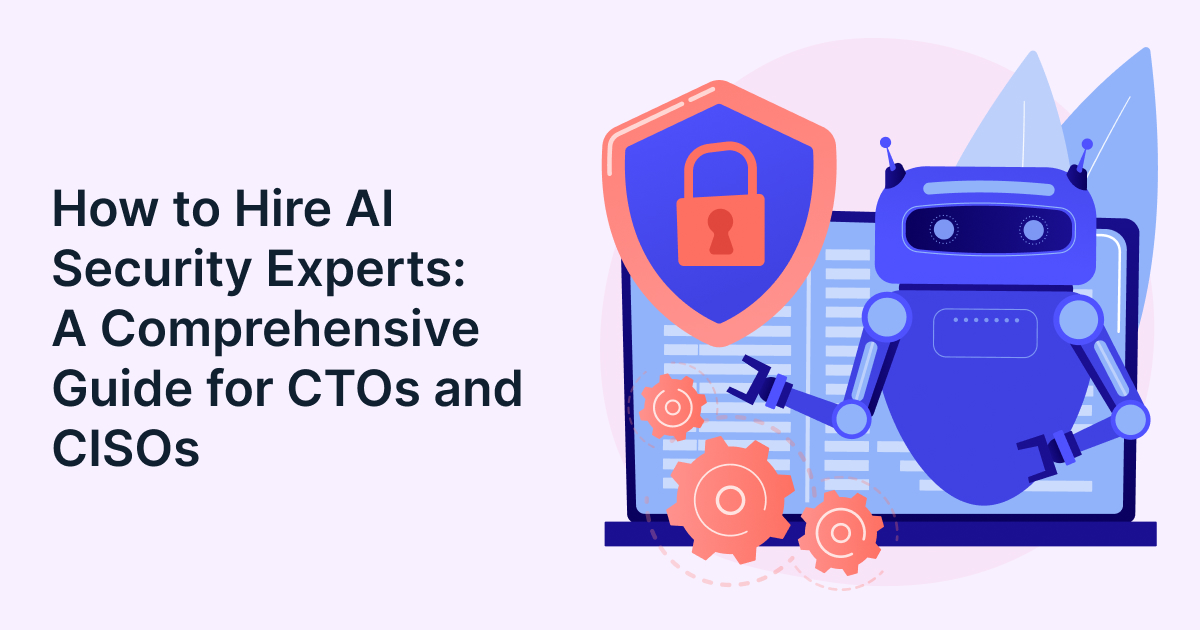
How to Hire AI Security Experts: A Comprehensive Guide for CTOs and CISOs


As organizations deploy AI across products, infrastructure, and decision-making systems, the security risks expand dramatically. Traditional cybersecurity teams are often not equipped to handle threats unique to AI systems such as model poisoning, adversarial attacks, data leakage, or insecure ML pipelines. This has made the need to hire AI security experts a strategic priority for CTOs and CISOs.
This guide breaks down the AI security hiring process, from defining the right role to evaluating skills, compensation expectations, and where to find credible AI cyber talent.
Why Hiring AI Security Experts Is Different
AI systems introduce a new attack surface. Models learn from data, change behavior over time, and can be manipulated in ways that traditional software cannot. As a result, hiring for AI security is not just about cybersecurity experience or AI knowledge in isolation.
AI security experts need to understand:
- How AI and ML models work
- How attackers exploit AI systems
- How to secure data pipelines and model lifecycles
- How to balance security, performance, and explainability
This overlap makes finding AI cyber talent significantly harder than hiring for conventional security roles.
Defining the AI Security Engineer Role and Responsibilities
A common mistake in AI security hiring is writing vague or generic job descriptions. A strong AI security engineer job description should clearly define scope and expectations.
Key responsibilities often include:
- Securing ML pipelines and AI infrastructure
- Designing defenses against adversarial attacks
- Monitoring AI models for drift, abuse, and anomalies
- Integrating AI security tools into existing SOC workflows
- Supporting compliance and governance for AI systems
CTOs and CISOs should be explicit about whether the role is focused on defensive security, offensive testing, governance, or platform security.
Where to Find Qualified AI Security Talent
AI security professionals are still a niche group. Most come from one of two backgrounds: cybersecurity engineers who upskilled in AI, or AI engineers who moved into security.
Traditional hiring channels often fall short because:
- General job boards lack AI security filtering
- Many candidates overstate AI expertise
- Resumes do not reflect real-world AI threat experience
This is where curated platforms and networks become valuable. Platforms like expertshub.ai, which focus on AI-specific roles, help organizations connect with vetted professionals who already operate at the intersection of AI and security.
This reduces sourcing time and improves signal quality early in the hiring funnel.

Evaluating AI Security Skills: What to Look For Beyond Resumes
Resumes alone are unreliable for AI security roles. A structured evaluation process is essential.
Effective AI security hiring assessments typically include:
- Scenario-based threat modeling exercises
- Questions around securing ML pipelines and data
- Discussion of real-world AI attack vectors
- Evaluation of trade-offs between security and model performance
Well-designed AI security interview questions focus on reasoning and decision-making rather than tool memorization.
The AI Security Hiring Process: Best Practices for CTOs and CISOs
A strong AI security hiring process usually follows these steps:
- Define AI-specific security risks relevant to your organization
- Map those risks to role requirements
- Shortlist candidates with proven cross-domain experience
- Conduct technical and scenario-based interviews
- Validate communication and documentation skills
Because AI security roles often interact with engineering, product, and compliance teams, collaboration skills are as important as technical depth.
AI Security Experts Salary Expectations
Compensation is often a concern for leadership teams planning AI security hires.
In general:
- AI security engineers earn a premium over traditional security roles
- Compensation varies widely based on depth of AI expertise
- Senior AI security specialists often command leadership-level pay
Salary expectations are influenced by scarcity, regulatory exposure, and business criticality of AI systems. Benchmarking compensation using specialized AI hiring platform can help avoid under- or over-paying.
Full-Time vs Contract vs Global AI Security Hiring Models
Many organizations struggle to hire AI security experts locally due to limited supply. This has increased interest in:
- Contract or fractional AI security roles
- Global hiring and cross-border teams
- Project-based engagements for AI risk audits
Platforms like expertshub.ai support flexible hiring models, allowing organizations to access AI security expertise without long-term commitment when appropriate.
This is particularly useful for:
- AI security assessments
- Model risk reviews
- Red teaming and adversarial testing

Common AI Security Hiring Mistakes to Avoid
CTOs and CISOs should be cautious of:
- Hiring purely based on AI buzzwords
- Assuming data scientists can handle security by default
- Ignoring compliance and governance experience
- Rushing hiring without proper vetting
AI security failures are costly and often reputational. Precision matters more than speed.
Final Thoughts
Hiring AI security experts is no longer optional for organizations deploying AI at scale. The risks are real, the talent pool is limited, and the cost of mistakes is high.
A successful AI security hiring strategy combines:
- Clear role definitions
- Rigorous evaluation
- Realistic compensation planning
- Access to specialized talent networks
Whether building in-house capability or engaging external experts, CTOs and CISOs need structured, AI-specific hiring approaches. Platforms like expertshub.ai exist to support this shift, enabling organizations to identify, vet, and engage credible AI security professionals efficiently.
Frequently Asked Questions
AI security expertise becomes critical when:
- AI systems move toward production
- Models impact financial or regulatory decisions
- Sensitive data is used for training
- AI systems are exposed to external users
Early involvement reduces long-term risk.
AI security professionals need expertise across:
- Machine learning fundamentals
- Secure system architecture
- Threat modeling
- Adversarial attack techniques
- Data governance and compliance
The intersection of AI and cybersecurity knowledge is essential.
Author
Ravikumar Sreedharan

CEO & Co-Founder, Expertshub.ai
Ravikumar Sreedharan is the Co-Founder of ExpertsHub.ai, where he is building a global platform that uses advanced AI to connect businesses with top-tier AI consultants through smart matching, instant interviews, and seamless collaboration. Also the CEO of LedgeSure Consulting, he brings deep expertise in digital transformation, data, analytics, AI solutions, and cloud technologies. A graduate of NIT Calicut, Ravi combines his strategic vision and hands-on SaaS experience to help organizations accelerate their AI journeys and scale with confidence.
Latest Post
AI Freelance Rates in 2026: How Much AI Freelancers Earn
AI Freelancing Trends in 2026: How AI Is Changing Freelancing