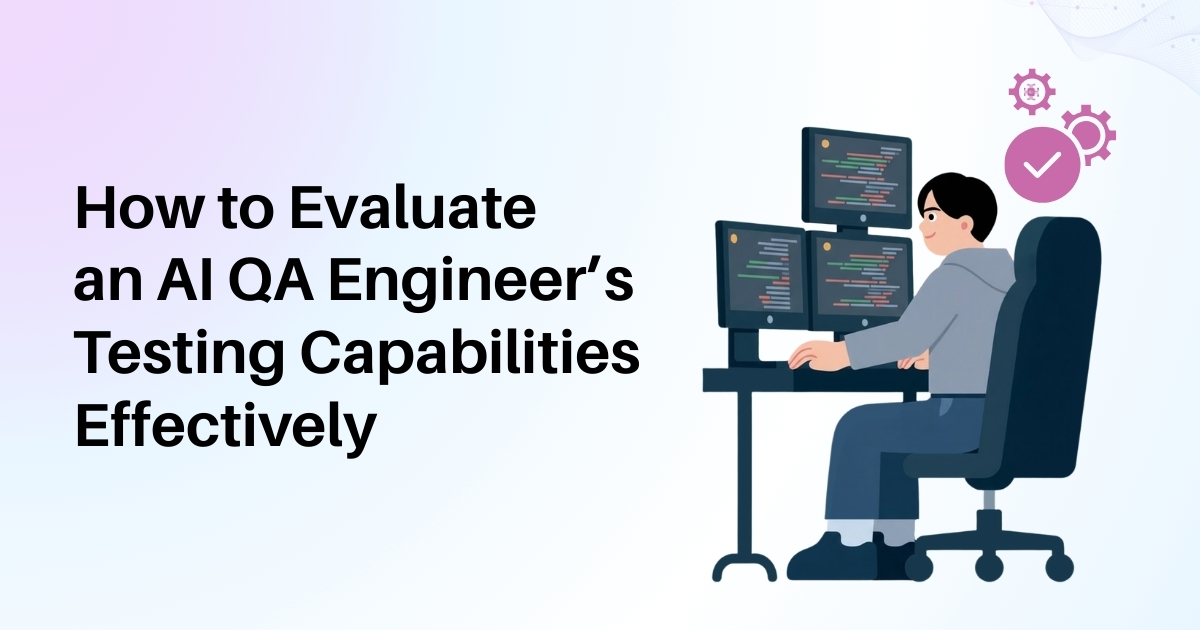
How to Evaluate an AI QA Engineer’s Testing Capabilities Effectively


As AI becomes embedded in products, QA roles are evolving rapidly. Testing AI systems is not the same as testing traditional software. Models are probabilistic, data-driven, and constantly changing. This makes evaluating AI QA engineers more nuanced than standard QA hiring.
If you rely on conventional interview questions or automation-heavy assessments, you risk hiring someone who is strong in traditional QA but unprepared for AI-specific challenges. This guide explains how to assess AI testing skills systematically, from interviews to hands-on evaluation.
Why Evaluating AI QA Engineers Requires a Specialized Approach
An AI QA engineers does more than validate outputs against expected results. They test systems where:
- Outputs vary for the same input
- Data quality affects behavior
- Models drift over time
- Bias, fairness, and robustness matter
Because of this, assessing AI testing experience requires looking beyond tool familiarity and focusing on mindset, reasoning, and approach.
Step 1: Check Foundational Understanding of AI Systems
Before testing skills, validate conceptual understanding.
An AI QA engineers should be able to explain:
- How machine learning models are trained and deployed
- The difference between deterministic logic and probabilistic outputs
- What model drift is and why it matters
- How data impacts system behavior
You are not looking for a data scientist, but the candidate must understand enough to test intelligently.
This is a key early filter when hiring AI QA engineers.

Step 2: Use AI QA Interview Questions That Test Real-World Thinking
Good AI QA interview questions focus on scenarios, not definitions.
- How would you test an AI model whose outputs change over time?
- How do you validate an AI system when there is no single “correct” answer?
- What steps would you take to detect bias in an AI feature?
- How would you design regression tests for a retrained model?
Strong candidates explain their reasoning clearly, acknowledge uncertainty, and focus on risk-based testing.
Step 3: Apply an AI Testing Skill Checklist
A structured AI testing skill checklist helps standardize evaluation.
Core areas to assess include:
AI-specific testing knowledge
- Bias and fairness testing
- Robustness and edge case testing
- Drift detection and monitoring
- Explainability validation
Data awareness
- Understanding of data quality issues
- Ability to reason about labeling errors
- Awareness of data leakage risks
Test strategy
- Designing test coverage for probabilistic systems
- Prioritizing high-risk scenarios
- Balancing automation and exploratory testing
Candidates do not need to be experts in all areas, but they should demonstrate awareness and curiosity.
Step 4: Run Scenario-Based AI QA Technical Tests for Real Evaluation
A strong AI QA technical test should reflect real-world AI testing challenges.
Instead of asking for code-heavy tasks, consider:
- A mock AI feature description with known risks
- Sample model outputs with inconsistencies
- A dataset with potential bias or noise
Ask the candidate to:
- Identify risks
- Propose a test strategy
- Define metrics they would track
- Explain how they would report findings
This reveals how they think, not just what they know.
Step 5: Evaluate Experience With AI Test Metrics
AI QA engineers should be comfortable with metrics beyond pass or fail.
Look for familiarity with:
- Accuracy and confidence thresholds (at a conceptual level)
- Monitoring trends rather than single results
- Comparing model versions
- Interpreting false positives and false negatives
Candidates who only think in binary terms often struggle with AI systems.
Step 6: Assess Collaboration and Communication Skills
AI QA work is deeply cross-functional. QA engineers must collaborate with data scientists, AI engineers, PMs, and sometimes legal or compliance teams.
Assess:
- How they communicate complex issues simply
- How they document findings and recommendations
- Whether they push back constructively on unrealistic expectations
Strong communication is often what differentiates effective AI QA engineers from average ones.
Step 7: Look for Evidence of Learning, Not Just Experience
AI testing is still evolving. Tools, risks, and best practices change quickly.
When evaluating AI QA engineers, value:
- Continuous learning mindset
- Exposure to different AI systems or domains
- Willingness to adapt testing strategies
Candidates who rely only on fixed checklists often struggle as AI systems mature.
Using External AI QA Talent
Because AI QA skills are still rare, many teams supplement internal hiring with external experts. Platforms like expertshub.ai can help teams access vetted AI QA specialists who already have hands-on experience testing AI systems across domains. This is especially useful when internal teams are transitioning from traditional QA to AI-focused quality assurance.

Common Evaluation Mistakes to Avoid
Avoid:
- Treating AI QA like standard automation testing
- Over-indexing on tools instead of reasoning
- Ignoring data and model lifecycle understanding
- Skipping scenario-based assessments
These mistakes often lead to hires who struggle once real AI complexity emerges.
Final Thoughts
Evaluating an AI QA engineer requires a shift in mindset. You are not just hiring someone to execute test cases, but someone who can reason about uncertainty, data risk, and evolving systems.
A strong evaluation process combines:
- Conceptual understanding checks
- Scenario-based interview questions
- Practical AI QA technical tests
- Assessment of communication and adaptability
As AI becomes core to product quality, teams that learn how to assess AI testing skills effectively will build more reliable, trustworthy systems. Over time, aligning this evaluation with the right talent sources and frameworks, including platforms like expertshub.ai, can significantly reduce hiring risk and accelerate AI readiness.
Frequently Asked Questions
AI QA testing involves probabilistic outputs, data drift, bias detection, and model evolution rather than fixed pass/fail results. Traditional QA expects consistent behavior; AI QA focuses on risk assessment, robustness, and continuous monitoring across changing conditions.
AI QA expertise remains rare, so many teams use vetted talent platforms like expertsHub.ai to access specialists with production AI testing experience across domains while building internal capabilities.
Segment performance by demographics, check confidence disparities, test proxy discrimination, monitor data imbalances. Expertshub.ai’s AI QAs ensure fairness compliance from Day 1.
Author
Ravikumar Sreedharan

CEO & Co-Founder, Expertshub.ai
Ravikumar Sreedharan is the Co-Founder of ExpertsHub.ai, where he is building a global platform that uses advanced AI to connect businesses with top-tier AI consultants through smart matching, instant interviews, and seamless collaboration. Also the CEO of LedgeSure Consulting, he brings deep expertise in digital transformation, data, analytics, AI solutions, and cloud technologies. A graduate of NIT Calicut, Ravi combines his strategic vision and hands-on SaaS experience to help organizations accelerate their AI journeys and scale with confidence.
Latest Post
AI Freelance Rates in 2026: How Much AI Freelancers Earn
AI Freelancing Trends in 2026: How AI Is Changing Freelancing