How to Hire RLHF Engineers for LLM Alignment Projects (2026 Guide)


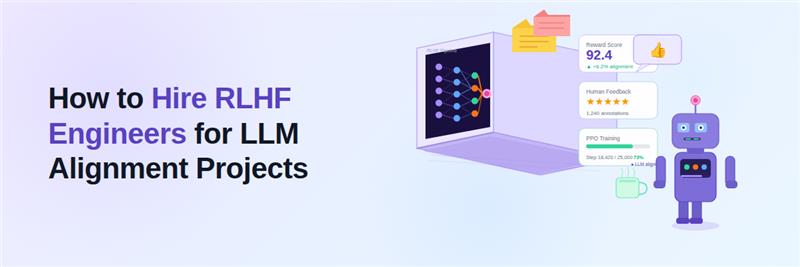
Large Language Models (LLMs) are only as good as their alignment. Without proper tuning, they hallucinate, generate unsafe outputs, or fail to meet business expectations. This is where RLHF (Reinforcement Learning from Human Feedback) becomes critical and why companies are actively looking to hire RLHF engineers.
From enterprise copilots to AI agents and domain-specific chatbots, RLHF ensures models behave predictably, safely, and in line with user intent. But hiring the right RLHF engineers is complex, this niche role blends machine learning, human-in-the-loop systems, and behavioral optimization.
This guide breaks down how to hire RLHF engineers for LLM alignment projects, including skills, costs, hiring models, and a step-by-step process tailored for CTOs and AI leaders.

What is RLHF and Why It Matters for LLMs
RLHF (Reinforcement Learning from Human Feedback) is a training technique used to align LLM outputs with human preferences.
How RLHF Works (Simplified)
- Train a base model (pre-trained LLM)
- Collect human feedback on model outputs
- Train a reward model based on preferences
- Optimize the LLM using reinforcement learning (e.g., PPO)
Why RLHF is Critical
- Reduces hallucinations and harmful outputs
- Improves response quality and relevance
- Aligns models with business-specific goals
- Enables safe deployment in production environments
Real-world example:
Chat-based AI assistants in fintech or healthcare rely heavily on RLHF to ensure compliance and safe responses.
When Do You Need RLHF Engineers?
Not every AI project needs RLHF. You should hire RLHF engineers when:
Use Cases That Require RLHF
- Building AI copilots or assistants
- Training domain-specific LLMs (legal, medical, finance)
- Developing customer-facing chatbots
- Deploying AI agents with decision-making capabilities
- Improving existing LLM outputs with human feedback loops
When RLHF May Not Be Needed
- Basic prompt engineering tasks
- Small-scale prototypes
- Static NLP models without user interaction
RLHF Engineer Roles & Responsibilities
An RLHF engineer operates at the intersection of ML engineering and human feedback systems.
Core Responsibilities
- Design human feedback pipelines
- Build and train reward models
- Implement RL algorithms (e.g., PPO, DPO)
- Optimize LLM outputs based on feedback
- Collaborate with data annotators and domain experts
- Evaluate model performance and alignment metrics
Supporting Roles in RLHF Ecosystem
- RLHF Data Curators
- Prompt Engineers
- ML Engineers
- Domain Experts
Skills Checklist for Hiring RLHF Engineers
When you hire RLHF engineers, look beyond traditional ML skills.
Must-Have Skills
- Reinforcement Learning (RL) – PPO, DPO, policy gradients
- Reward Modeling – preference learning, ranking models
- Prompt Engineering – designing evaluation prompts
- Human Feedback Systems – annotation workflows
- Python + ML Frameworks – PyTorch, TensorFlow
- LLM Fine-tuning – Hugging Face, OpenAI APIs
Nice-to-Have Skills
- Experience with RLHF pipelines (OpenAI, Anthropic-style)
- Knowledge of alignment techniques (constitutional AI, RLAIF)
- Familiarity with evaluation benchmarks (BLEU, ROUGE, human evals)
Tools & Stack
- Hugging Face Transformers
- RL libraries (TRL, Ray RLlib)
- Labeling tools (Scale AI, Labelbox)
- Experiment tracking (Weights & Biases)
RLHF vs Fine-Tuning vs Prompt Engineering
Understanding the differences helps you hire the right talent.
| Approach | Use Case | Complexity | When to Use |
| Prompt Engineering | Quick improvements | Low | Early-stage projects |
| Fine-Tuning | Domain adaptation | Medium | Structured datasets |
| RLHF | Behavioral alignment | High | Production-grade LLMs |
For enterprise-grade AI systems, RLHF is often the final and most critical layer.
Hiring Models for RLHF Engineers
Different hiring models suit different project needs.
Freelance / Contract
- Best for short-term RLHF pipelines
- Faster onboarding
- Cost-effective
Full-Time Hiring
- Ideal for long-term AI strategy
- Better alignment with internal teams
Dedicated Remote Teams
- Scalable and flexible
- Faster time-to-hire
Cost of RLHF Engineers in the US
RLHF engineers are among the highest-paid AI roles due to niche expertise.
Estimated Cost (2026)
| Level | Hourly Rate | Annual Salary |
| Junior | $50–$90 | $100K–$140K |
| Mid-Level | $90–$150 | $140K–$200K |
| Senior | $150–$250+ | $200K–$350K+ |
Cost Drivers
- Experience in RLHF pipelines
- Domain expertise (healthcare, finance)
- Familiarity with large-scale LLM deployment
- Geographic location
Step-by-Step Process to Hire RLHF Engineers
Step 1: Define Your Alignment Goals
- What behavior do you want to optimize?
- Safety, accuracy, tone, or domain expertise?
Step 2: Identify Required Skills
- Do you need PPO expertise?
- Or reward modeling + annotation pipeline design?
Step 3: Choose Hiring Model
- Freelance vs full-time vs platform-based hiring
Step 4: Evaluate Candidates
Look for:
- Past RLHF or alignment experience
- Real-world LLM projects
- Understanding of human feedback loops
Step 5: Run Technical Assessment
- Case study: Improve LLM outputs using feedback
- Evaluate reasoning and experimentation
Step 6: Start with Pilot Project
- Test with a small RLHF pipeline
- Measure performance improvements
Step 7: Scale the Team
- Add annotators, domain experts, and ML engineers
What Does an RLHF Engineer Do?
An RLHF engineer designs and implements systems that improve AI model behavior using human feedback. They build reward models, create feedback loops, and apply reinforcement learning techniques to align LLM outputs with human preferences, ensuring safer, more accurate, and context-aware responses.
Real-World Use Cases of RLHF Engineers
- AI Customer Support Agents
- Improve tone and accuracy
- Reduce escalation rates
- Enterprise Knowledge Assistants
- Align responses with internal data
- Ensure compliance and reliability
- AI Coding Assistants
- Optimize code suggestions
- Reduce hallucinated outputs
- Healthcare AI Systems
- Ensure safe, ethical responses
- Align with medical guidelines
Key Takeaways
- RLHF is essential for aligning LLMs with human expectations
- Hiring RLHF engineers requires niche expertise in RL + human feedback system
- Costs are high, but ROI is significant for production AI systems
- Choose the right hiring model based on project scale
- Always start with a pilot before scaling RLHF pipelines

Final Thoughts
Hiring the right RLHF engineers can be the difference between a functional AI model and a production-ready, aligned system. As LLM adoption accelerates, RLHF expertise is becoming a competitive advantage.
If you’re looking to hire RLHF engineers for LLM alignment projects, access pre-vetted, production-ready AI talent on expertshub.ai without long hiring cycles.
Scale your AI team faster—with experts who understand alignment, not just models.
Frequently Asked Questions
Author
Ravikumar Sreedharan

CEO & Co-Founder, expertshub.ai
Ravikumar Sreedharan is the Co-Founder of expertsHub.ai, where he is building a global platform that uses advanced AI to connect businesses with top-tier AI consultants through smart matching, instant interviews, and seamless collaboration. Also the CEO of LedgeSure Consulting, he brings deep expertise in digital transformation, data, analytics, AI solutions, and cloud technologies. A graduate of NIT Calicut, Ravi combines his strategic vision and hands-on SaaS experience to help organizations accelerate their AI journeys and scale with confidence.
Latest Post

How to Hire AI Research Scientists for Deep Learning Projects (2026 Guide)

Explainable AI (XAI) Experts: Why Businesses Need Them in 2026