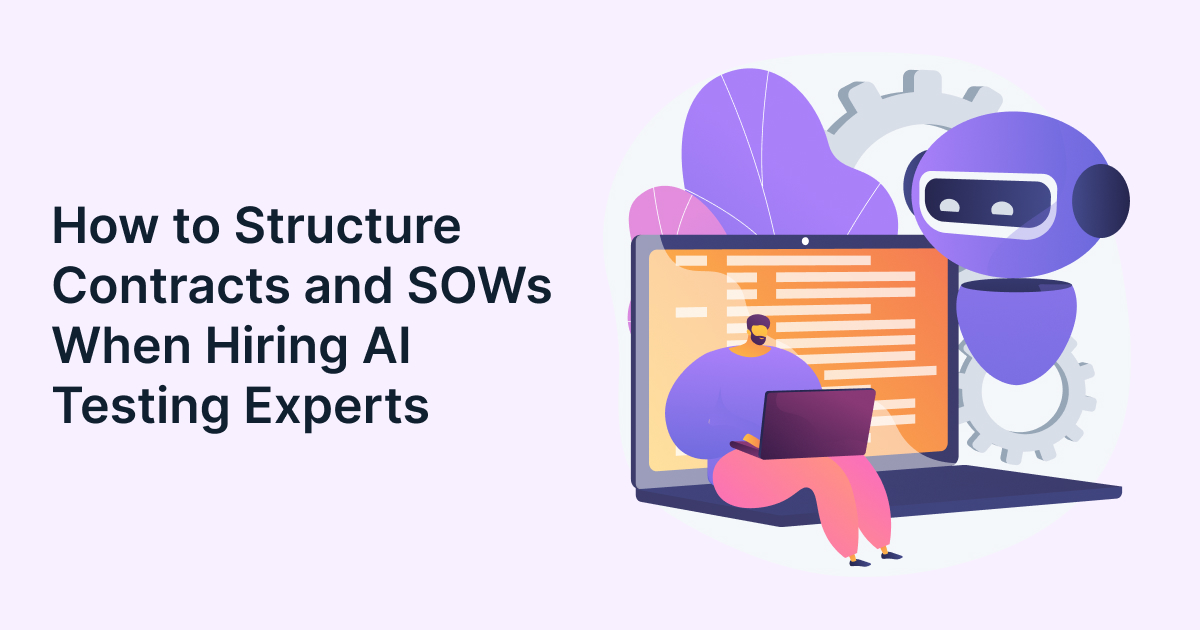
How to Structure Contracts and SOWs When Hiring AI Testing Experts


As AI-driven systems become central to products and platforms, testing them requires a very different approach from traditional software QA. AI testing involves probabilistic outcomes, evolving models, data dependencies, and continuous learning. Because of this, contracts and statements of work that work well for conventional QA often fall short when applied to AI.
For CTOs, Heads of Engineering, and Procurement teams, structuring the right contracts for AI testing experts is critical. A poorly defined SOW can lead to misaligned expectations, delivery disputes, or gaps in accountability. This guide explains how to structure AI QA contracts and SOWs clearly, practically, and defensibly.
Why AI Testing Contracts and SOWs Need a Different Structure
Traditional QA contracts assume deterministic behavior. If the code works today, it should work the same tomorrow. AI systems do not behave that way.
AI testing introduces:
- Non-deterministic outputs
- Continuous model updates and drift
- Data-dependent performance
- Statistical success metrics rather than binary pass or fail
Because of this, AI QA SOWs must focus more on process, coverage, and risk reduction rather than absolute guarantees.
Defining Scope in an AI Testing Statement of Work (SOW)
A strong AI testing statement of work starts with precise scoping. Vague language like “end-to-end AI testing” often leads to confusion.
Your SOW should clearly define:
- Type of AI system being tested (ML model, LLM, computer vision, recommender, etc.)
- Testing focus areas (accuracy, bias, robustness, security, performance, explainability)
- Environments included (training, staging, production monitoring)
- In-scope and out-of-scope components
This clarity protects both parties and makes performance evaluation easier.
Choosing the Right AI QA Engagement Model for Testing Projects
Before drafting contract terms, decide on the engagement model. Common AI QA engagement models include:
Project-based AI Testing SOW
Best for audits, validation cycles, or pre-launch testing. Scope and timelines are fixed.
Retainer or ongoing QA support
Useful for continuous monitoring, regression testing, and model drift analysis.
Milestone-based AI QA engagement
Works well when AI systems are evolving and deliverables are tied to phases like model release, retraining, or feature rollout.
Platforms like expertshub.ai often support multiple engagement models, making it easier to align contracts with how AI testing work actually happens.

Key AI QA Contract Clauses to Include in AI Testing Agreements
AI QA contracts should include clauses that reflect the realities of AI systems. Some essential AI QA contract clauses include:
Performance variability clause for AI systems
Acknowledge that AI outputs are probabilistic and that performance is measured statistically, not absolutely.
Data dependency clause for AI testing
Clarify responsibilities around data access, data quality, and data changes that may affect test results.
Model change clause for retraining and updates
Specify how scope and timelines adjust when models are retrained, fine-tuned, or replaced.
Explainability and reporting clause for AI QA
Define expectations for documentation, insights, and reporting, not just defect counts.
These clauses help avoid disputes caused by misunderstanding how AI behaves.
Defining Performance SLAs for AI Testing and QA
One of the hardest parts of AI QA contracts is defining SLAs. Traditional SLAs like “zero defects” or “100% pass rate” are unrealistic for AI systems.
Effective performance SLAs for AI tests often focus on:
- Test coverage metrics
- Detection of bias, drift, or degradation
- Time-to-detection for critical issues
- Quality and clarity of test reports
- Responsiveness to retraining or model changes
SLAs should emphasize risk reduction and visibility rather than perfection.
Intellectual Property and Ownership in AI Testing Contracts
AI testing often generates artifacts such as:
- Test datasets
- Synthetic data
- Evaluation frameworks
- Custom scripts and tooling
Contracts should clearly define:
- Ownership of test artifacts
- Reuse rights across projects
- Confidentiality and data handling
- Restrictions on using findings elsewhere
This is especially important when external experts or global teams are involved.
Legal Terms for AI Testing Contracts and Compliance
Depending on industry and geography, legal terms for AI testing may need to address:
- Data privacy and protection
- Regulatory compliance
- Security controls
- Audit rights
For regulated industries, AI QA contracts should align with internal governance and compliance requirements. This is an area where legal, security, and engineering teams must collaborate closely.
Managing Change and Scope Creep in AI QA SOWs
AI projects evolve quickly. Without a clear change management mechanism, SOWs can become outdated within weeks.
Include:
- A formal change request process
- Impact assessment on timelines and cost
- Clear approval workflows
This keeps the engagement flexible without sacrificing control.
Full-Time vs External AI Testing Experts : What Works Best?
Some organizations choose to build in-house AI QA teams. Others rely on external specialists due to scarcity or cost.
When hiring externally, working with platforms like expertshub.ai allows organizations to:
- Standardize contracts and engagement terms
- Scale AI QA support up or down as needed
This flexibility is especially useful for fast-moving AI product teams.

Common AI Testing Contract Mistakes to Avoid
When structuring AI QA contracts, avoid:
- Treating AI testing like traditional QA
- Overpromising deterministic outcomes
- Ignoring data and model dependencies
- Using generic software testing templates
These mistakes often lead to misaligned expectations and strained relationships.

Final Thoughts
AI testing requires contracts and SOWs that reflect uncertainty, evolution, and statistical performance. Clear scope definition, realistic SLAs, and AI-aware legal terms are essential for successful engagements.
For organizations hiring AI testing experts, the goal is not to eliminate all risk, but to manage it transparently and systematically. Well-structured AI QA SOWs and contracts protect both the business and the experts delivering the work.
As AI adoption accelerates, frameworks and platforms like expertshub.ai can play a supporting role by helping organizations engage qualified AI QA professionals under well-defined, flexible contractual models.
Frequently Asked Questions
Author
Ravikumar Sreedharan

CEO & Co-Founder, expertshub.ai
Ravikumar Sreedharan is the Co-Founder of expertsHub.ai, where he is building a global platform that uses advanced AI to connect businesses with top-tier AI consultants through smart matching, instant interviews, and seamless collaboration. Also the CEO of LedgeSure Consulting, he brings deep expertise in digital transformation, data, analytics, AI solutions, and cloud technologies. A graduate of NIT Calicut, Ravi combines his strategic vision and hands-on SaaS experience to help organizations accelerate their AI journeys and scale with confidence.
Latest Post
How to Hire AI Research Scientists for Deep Learning Projects (2026 Guide)
Explainable AI (XAI) Experts: Why Businesses Need Them in 2026