Hire Machine Learning Engineers: A Complete Guide for 2026


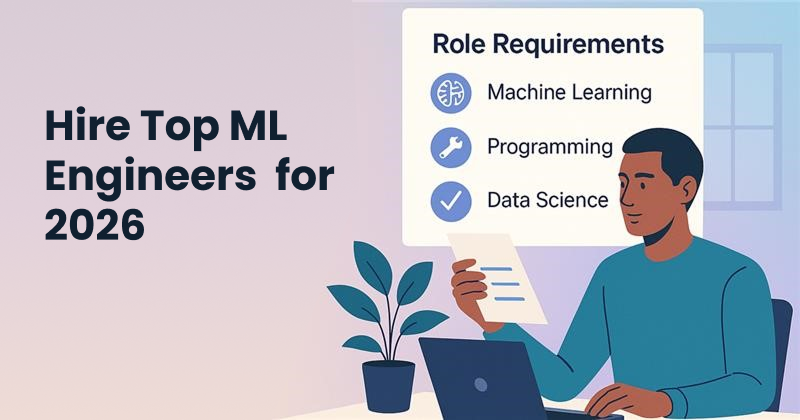
Hiring machine learning engineers in 2026 will be more challenging than ever due to a sharp increase in demand. This trend is driven by the rapid adoption of Generative AI (GenAI) and AI-driven digital transformations across various industries. However, the supply of qualified talent remains tight. This imbalance has led to increased salaries, prolonged hiring timelines, and greater risk of costly mismatches. With ML job postings more than doubling to 139,000 in just four months, organizations must adopt a strategic hiring framework that balances cost, speed, and quality.
This step-by-step guide will help you source, assess, and hire top ML engineers and specialists with precision.

How to Hire Machine Learning Engineers Effectively for Your Project
Hiring machine learning engineers requires a thorough understanding of your project’s requirements, the availability of suitable talent, and the most effective hiring format. Begin by defining the scope and complexity of the project. Are you looking for research expertise, algorithm modeling, or production deployment?
Next, choose the most appropriate hiring model based on your needs:
- Full-time employees for long-term, core ML initiatives
- Freelance ML engineers for short-term or highly specialized tasks
- Contract or agency hires for flexibility and scalability.
Follow these foundational steps to ensure a successful hire:
1. Define the Role Precisely
Identify whether you need a generalist ML engineer, an MLOps specialist, or a domain expert. Specify whether your priority lies in research, algorithmic innovation, or deployment automation.
2. Determine the Optimal Hiring Model
- Full-time hires: Provide committed and culture-aligned resources but come with higher upfront costs (salary + benefits + onboarding).
- Freelance ML engineers: Offer flexibility and speed, but require thorough vetting due to variable quality and minimal knowledge transfer.
3. Source Talent Strategically
Use a combination of recruiting approaches such as direct recruiting (LinkedIn, GitHub), specialized freelance platforms, and AI staffing agencies. Focus on platforms with verified portfolios and rigorous coding assessments.
4. Develop a Robust Screening Process
Incorporate technical evaluations (coding tests, ML problem-solving scenarios), portfolio reviews, and behavioral interviews aligned with AI product development.
5. Negotiate Offers Transparently
Base salary benchmarks and benefits should align with current market trends. Clearly communicate career growth opportunities and project details to improve candidate acceptance rates.
expertshub.ai uses a rigorous AI expert validation process to provide pre-vetted ML engineering talent, significantly reducing hiring risk and expediting time-to-hire.
Essential Skills for ML Engineers in 2026
The skillset required of machine learning engineers is evolving rapidly, with a growing emphasis on production-ready capabilities and specialization in GenAI.
Core Technical Skills
- Programming Languages: Python remains the standard. However, Java has surpassed SQL in job postings (21% vs. 18%), reflecting the shift towards production deployment.
- Machine Learning Frameworks: Proficiency in TensorFlow, PyTorch, and Scikit-learn is essential for efficient model development.
- Cloud Computing: AWS is cited in 33% of ML engineer job postings as a mandatory skill for deploying scalable AI models.
- MLOps Tools: Competence in CI/CD pipelines, Docker, Kubernetes, model monitoring, and automated retraining pipelines is becoming increasingly important.
Specialized Knowledge
- GenAI and Large Language Models (LLMs): Familiarity with prompt engineering, fine-tuning, and retrieval-augmented generation (RAG) systems is a significant advantage.
- Domain Expertise: 57.7% of roles specifically seek candidates who understand the unique challenges of key industries such as finance, healthcare, or manufacturing.
- Education: While 36.2% of job postings require a PhD, 23.9% focus more on skills and experience than formal degrees.
Soft Skills
- Problem-solving and creativity to develop cutting-edge ML solutions
- Strong communication skills to bridge data science and business teams
- The ability to thrive in remote and hybrid work environments, collaborating effectively with cross-functional teams
What Are the Rates for Hiring Machine Learning Engineers in the US?
The compensation for machine learning engineers varies significantly according to experience, location, and skill specialization:
| Experience Level | Base Salary (US) | Total Compensation Estimate |
| 0–1 Year | $118,000 | $145,000 |
| 2–3 Years | $134,000 | $165,000 |
| 4–6 Years | $156,000 | $190,000 |
| 7–9 Years | $169,000 | $207,000 |
| 10+ Years | $191,000+ | $230,000+ |
Geographic differentiation: San Francisco offers premiums of approximately $245K base, New York is around $227K, while Seattle averages $180K.
Freelance ML engineers typically charge rates varying from $80 to $250 per hour, depending on experience and specialization. Freelancers with GenAI expertise, due to scarcity and high demand, often command rates approximately 25% higher than standard ML engineers.
How to Effectively Assess ML Engineering Portfolios
When evaluating a candidate’s portfolio, use this focused rubric:
- Project Relevance: Confirm that projects align with your industry or problem domain, demonstrating real-world application of ML skills (e.g., healthcare analytics, financial risk modeling).
- Technical Depth: Look for projects that use advanced algorithms, incorporate scalable architectures, and follow clean coding practices. Preference should be given to end-to-end deployments and MLOps integration.
- Complexity & Impact: Check for evidence of solving complex problems, optimizing models, or enhancing business outcomes.
- Diverse Experience: Ensure a balance of research, development, and production-level experience.
- Community Engagement: Consider candidates’ open source contributions and research publications as indicators of thought leadership.
Always verify technical skills through a combination of code reviews and targeted assessments.
When to Hire Freelance versus Full-Time ML Engineers?
The choice between freelance and full-time ML engineers should be based on clearly identified strategic objectives:
- Hire Freelance ML engineers when:
- The work is short-term, experimental, or requires specialized skills not continually needed.
- You want rapid scaling without the commitments of full-time employment.
- Budget constraints favor variable hourly costs over fixed salaries.
- Hire Full-time ML engineers when:
- AI initiatives are an integral part of your product’s future, requiring ongoing collaboration and knowledge retention.
- Deep domain expertise is crucial for integration with engineering and product teams.
- Your goal is to nurture a culture of innovation and invest in talent retention.
Hybrid hiring models, combining both employees and freelancers, can provide a balanced blend of flexibility and cost-efficiency.
Why a Strategic Hiring Approach is Critical in 2026
With the widening talent gap, hiring machine learning engineers today requires a data-driven, strategic approach. Understanding current market rates, necessary skills, and the most suitable hiring model reduces risk and accelerates project success.
Start your hiring journey confidently by exploring expertshub.ai, where pre-vetted AI experts help scale your machine learning teams efficiently and effectively.

FAQs: Key Questions on Hiring ML Engineers
Author
Ravikumar Sreedharan

CEO & Co-Founder, Expertshub.ai
Ravikumar Sreedharan is the Co-Founder of ExpertsHub.ai, where he is building a global platform that uses advanced AI to connect businesses with top-tier AI consultants through smart matching, instant interviews, and seamless collaboration. Also the CEO of LedgeSure Consulting, he brings deep expertise in digital transformation, data, analytics, AI solutions, and cloud technologies. A graduate of NIT Calicut, Ravi combines his strategic vision and hands-on SaaS experience to help organizations accelerate their AI journeys and scale with confidence.
Latest Post

Top Skills to Look for in Autonomous Systems Engineers
Essential Skills to Look for in Machine Learning Engineers