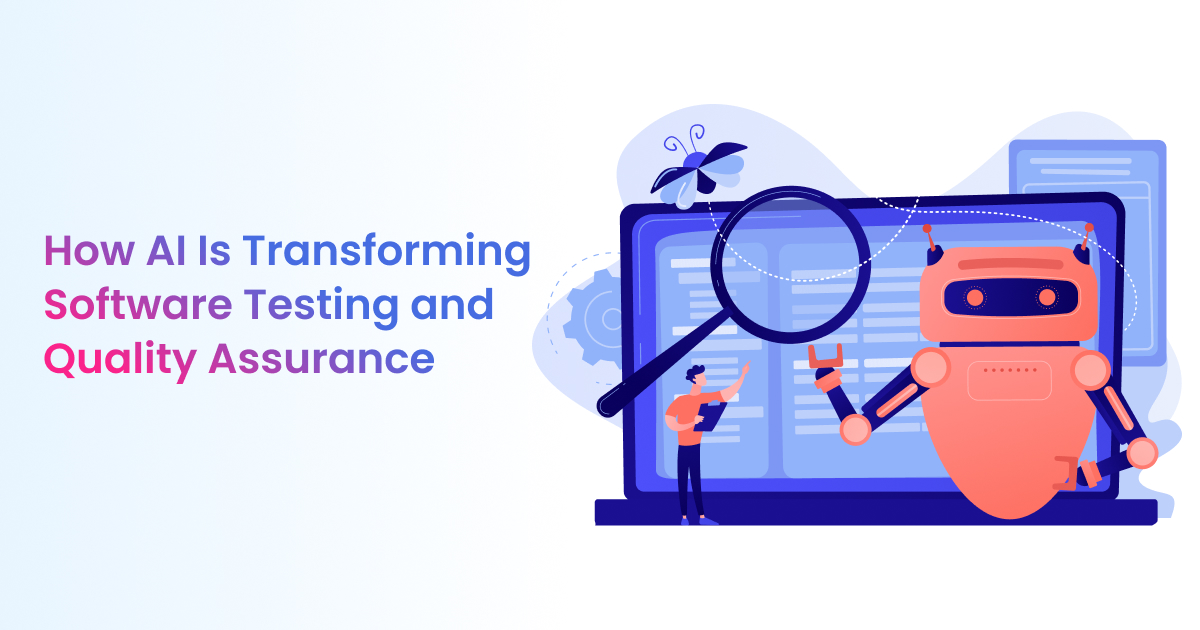
How AI Is Transforming Software Testing and Quality Assurance

Software testing and quality assurance have always been critical to building reliable products. But as software systems become more complex, release cycles shorter, and user expectations higher, traditional testing approaches are struggling to keep up. This is where artificial intelligence is reshaping the landscape.
The use of AI in software testing is moving QA from a reactive, manual-heavy process to a more intelligent, predictive, and scalable discipline. From smarter test automation to improved coverage and faster regression cycles, AI is changing not just how testing is done, but what quality means in modern software development.

Conventional QA relies heavily on manually written test cases, static automation scripts, and predefined rules. While effective to a point, these methods face several challenges:
As applications evolve continuously, QA teams need systems that can adapt just as quickly. This is where AI for QA automation comes in.
AI introduces learning, pattern recognition, and decision-making capabilities into the testing process. Instead of following rigid instructions, AI-driven systems can analyze application behavior, historical test data, and user interactions to make smarter testing decisions.
Key areas where AI is transforming QA include:
The goal is not to replace QA engineers, but to amplify their effectiveness.
AI-driven test automation goes beyond traditional scripted automation. Instead of relying only on fixed selectors or workflows, AI models can adapt to changes in the application.
For example:
This significantly reduces the time QA teams spend fixing broken tests after every release, allowing them to focus on higher-value validation.
One of the most powerful applications of AI in QA is intelligent test case generation. Writing comprehensive test cases manually is time-consuming and often incomplete.
AI systems can:
This leads to broader and more realistic test coverage compared to manually designed test suites.
Ensuring adequate test coverage is a persistent challenge. Teams often struggle to balance speed with completeness.
Using machine learning for test coverage, AI can:
Rather than aiming for maximum coverage in theory, AI helps teams focus on meaningful coverage that aligns with real-world risk.
Regression testing is one of the most time-consuming aspects of QA, especially in large applications with frequent updates.
AI-powered regression testing improves this by:
This allows teams to run faster regression cycles and release more frequently with confidence.
A growing ecosystem of AI tools for QA engineers is emerging to support these capabilities. These tools often integrate with CI/CD pipelines and existing test frameworks.
Common features include:
Rather than replacing existing tools, AI often enhances them, making QA workflows more efficient and data-driven.
As AI becomes embedded in testing, the role of QA engineers is evolving.
Instead of spending most of their time on repetitive manual testing, QA professionals increasingly focus on:
AI handles scale and repetition, while humans provide judgement, context, and critical thinking.
Organizations adopting AI in QA report several benefits:
These improvements are particularly valuable in agile and DevOps environments where speed and quality must coexist.
While AI brings clear advantages, it also introduces challenges:
Successful adoption requires a balanced approach where AI augments, rather than replaces, human expertise.
AI in software testing is still evolving, but its trajectory is clear. As applications become more complex and dynamic, intelligent testing will become essential rather than optional.
Future developments are likely to include:
QA will increasingly be seen not as a bottleneck, but as a strategic enabler of faster, safer innovation.

AI is transforming software testing and quality assurance by making it smarter, faster, and more aligned with real-world usage. From AI-driven test automation and intelligent test case generation to AI-powered regression testing, these technologies are redefining how quality is achieved.
For QA engineers, this shift opens opportunities to work more strategically and creatively. For organizations, it enables higher-quality software delivered at speed.
The future of QA is not manual versus automated. It is intelligent, adaptive, and human-guided.
Author

CEO & Co-Founder, Expertshub.ai
Ravikumar Sreedharan is the Co-Founder of ExpertsHub.ai, where he is building a global platform that uses advanced AI to connect businesses with top-tier AI consultants through smart matching, instant interviews, and seamless collaboration. Also the CEO of LedgeSure Consulting, he brings deep expertise in digital transformation, data, analytics, AI solutions, and cloud technologies. A graduate of NIT Calicut, Ravi combines his strategic vision and hands-on SaaS experience to help organizations accelerate their AI journeys and scale with confidence.