Hiring an AI Product Manager: Skills, Interview Questions, and More

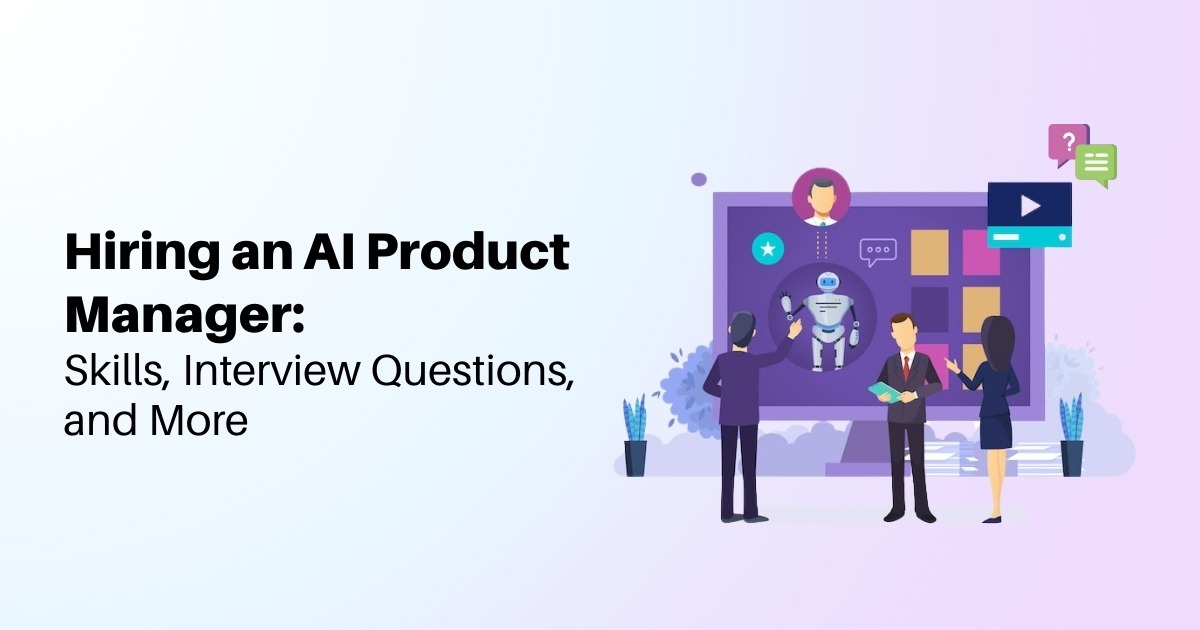
An AI product manager is responsible for translating artificial intelligence capabilities into measurable business outcomes while managing technical uncertainty, data dependencies, and cross-functional execution. Unlike traditional product roles, AI product management requires balancing experimentation with delivery discipline.
As AI adoption accelerates, organizations are formalizing machine learning product leadership instead of treating AI as a side initiative. According to the World Economic Forum’s Future of Jobs Report, AI and machine learning–related roles are among the fastest-growing globally.
This shift increases demand for strong AI product managers who can align engineering teams, data scientists, and business leaders under one coherent roadmap.
If your organization is scaling enterprise AI strategy, hiring the right AI product manager becomes a leverage decision, not just a headcount addition.
An effective AI product manager blends technical fluency, commercial thinking, and operational discipline. The role sits at the intersection of machine learning product leadership and AI project management, requiring depth across multiple dimensions.
An AI product manager does not need to build models, but must understand how models work. This includes knowledge of training data dependencies, model evaluation metrics, experimentation cycles, deployment constraints, and monitoring requirements.
They should understand trade-offs between accuracy, latency, cost, and scalability. Familiarity with concepts like model drift, feature engineering, LLM fine-tuning, and retrieval-augmented generation is increasingly important in GenAI contexts.
Without technical literacy, roadmaps become unrealistic and stakeholder expectations misaligned.
AI initiatives must tie directly to revenue growth, operational efficiency, or risk reduction. An AI product manager must prioritize use cases based on ROI, not novelty.
Strong candidates demonstrate the ability to convert ambiguous AI capabilities into structured product strategies. They know when to build in-house, when to integrate APIs, and when to pivot based on market signals.
Enterprise AI strategy fails when experimentation is not anchored to measurable value.
AI product management is inherently cross-functional. The AI product manager must align data scientists, engineers, compliance teams, executives, and sometimes regulators.
Clear communication reduces friction between technical and business stakeholders. The best candidates can translate model performance metrics into business impact language and explain limitations honestly.
An AI product manager must rely on evidence rather than assumptions. They define measurable KPIs before development begins and track model performance, user engagement, and financial impact continuously.
They also understand that experimentation is core to AI project management. Structured A/B testing, evaluation baselines, and performance dashboards are not optional.
AI product management introduces complexity that traditional product roles rarely face.
AI systems are probabilistic. Model outcomes may vary across datasets and environments. Timelines are harder to predict compared to deterministic software features.
An AI product manager must structure experimentation cycles without losing delivery momentum. They define hypotheses, success criteria, and iteration loops clearly.
Artificial intelligence governance is central to modern AI product management. Issues of bias, explainability, compliance, and data privacy must be addressed proactively.
AI product managers work closely with legal and compliance teams to ensure documentation standards, audit readiness, and responsible deployment practices.
In regulated industries, this oversight becomes mission-critical.
AI products depend on coordinated effort across modeling, data engineering, infrastructure, and business teams.
The AI product manager ensures that dependencies are visible, bottlenecks are managed, and deployment readiness is evaluated holistically.
Organizations that underestimate cross-functional alignment often experience delays and rework.

Hiring an AI product manager requires structured evaluation beyond standard product interviews.
Start by assessing technical fluency. Ask candidates to explain a real AI product they have managed. Probe how they defined evaluation metrics, handled model uncertainty, and aligned with engineering constraints.
Evaluate strategic thinking by presenting a hypothetical AI use case and asking how they would prioritize features, define KPIs, and sequence delivery.
Assess stakeholder management skills through behavioral questions focused on conflict resolution between data science and business teams.
Structured evaluation improves hiring accuracy. Platforms like expertshub.ai can help organizations define AI role requirements clearly and access pre-vetted candidates aligned with enterprise AI strategy needs.
A newly hired AI product manager should not operate in isolation.
During the first 30 days, they should map existing AI initiatives, understand data infrastructure maturity, and review governance frameworks. Clear access to engineering and analytics dashboards accelerates ramp-up.
Establish defined ownership boundaries early. Clarify how the AI product manager interacts with data science leads, MLOps engineers, and executive stakeholders.
Successful onboarding reduces friction and shortens time to impact.
The career path for an AI product manager typically evolves toward senior product leadership or strategic AI roles.
At mid-level stages, the focus remains on delivery execution. At senior levels, machine learning product leadership expands to portfolio strategy, AI governance frameworks, and enterprise AI transformation initiatives.
As AI becomes embedded in core business systems, experienced AI product managers often transition into Chief AI Officer or Head of AI roles.
Organizations investing early in structured AI project management often develop strong internal leadership pipelines.

Author

CEO & Co-Founder, Expertshub.ai
Ravikumar Sreedharan is the Co-Founder of ExpertsHub.ai, where he is building a global platform that uses advanced AI to connect businesses with top-tier AI consultants through smart matching, instant interviews, and seamless collaboration. Also the CEO of LedgeSure Consulting, he brings deep expertise in digital transformation, data, analytics, AI solutions, and cloud technologies. A graduate of NIT Calicut, Ravi combines his strategic vision and hands-on SaaS experience to help organizations accelerate their AI journeys and scale with confidence.