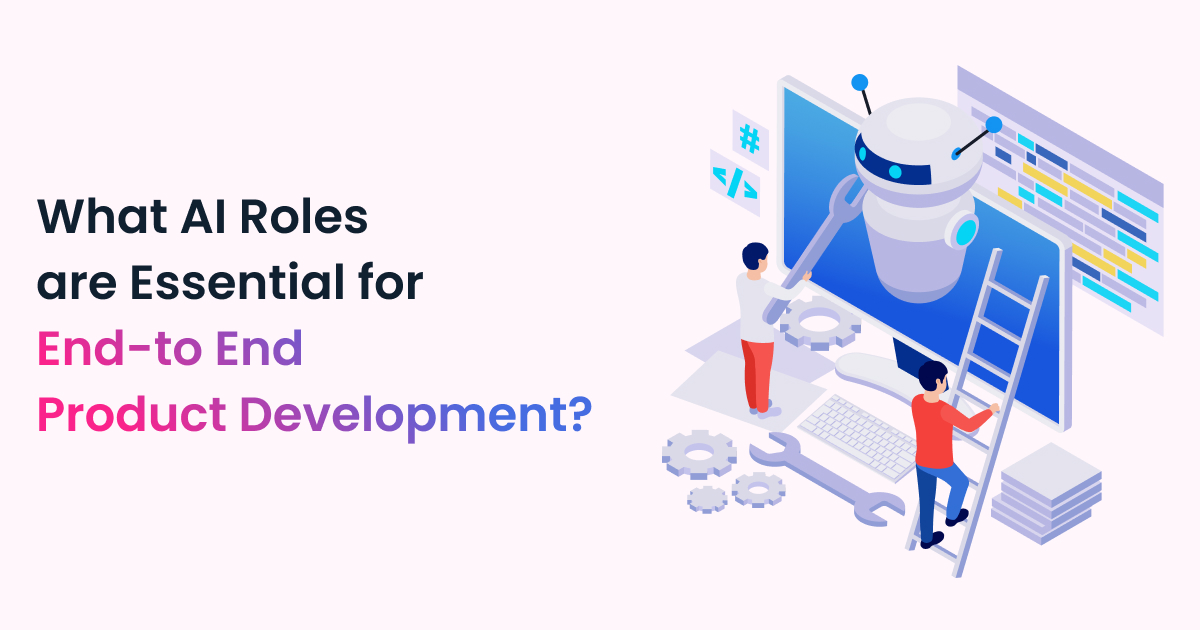
What AI Roles are Essential for End-to-End Product Development? (2026 Battle‑Tested Guide)


Building an AI product in 2026 requires a team that understands both technology and real business outcomes. Companies often focus on hiring individual experts, but the true success of an AI product comes from collaboration across engineering, research, design, and strategic functions. As AI continues to evolve, the lines between roles may shift, yet the foundation remains the same. An effective end-to-end AI product team balances innovation, product thinking, responsible development, and high-quality execution.
In this landscape, understanding the AI roles product development requires at every stage has become critical. From problem framing to deployment, each professional contributes to a specific layer of value. The industry has also seen clearer patterns in AI product team structure, especially in terms of skills overlap, team ratios, and hiring models that allow companies to scale. With these trends in mind, let us explore how modern AI teams operate, who drives which tasks, and how startups can build sustainable AI teams without overspending.

How do AI engineers, Data scientists, and Product managers collaborate?
AI development is complex, which is why the collaborative triangle of product managers, data scientists, and AI engineers is at the center of every successful product. Their partnership ensures that technical decisions align with user needs, business constraints, and deployment realities.
Product managers shape the direction by defining outcomes, prioritizing features, and ensuring that the team works toward the right goals. Data scientists validate feasibility, explore data patterns, and test algorithmic approaches. AI engineers build the systems that transform these models into functioning, scalable products.
To make their collaboration clearer, the core responsibilities of each role can be understood through three simple focus areas:
- Product managers handle goal setting, roadmap planning, user needs, feature prioritization, and ensuring that the product aligns with business outcomes.
- Data scientists explore data, run experiments, build prototype models, choose algorithms, and validate whether the technical direction is viable.
- AI engineers convert models into production systems, ensure performance, manage infrastructure, and maintain ongoing reliability and updates.
These responsibilities, when combined, create a balanced AI development team composition that can move ideas from concept to successful deployment without unnecessary delays or misalignment.
Which roles handle model training vs deployment?
AI product development is typically divided into model training and model deployment, and each phase requires specialists with different strengths. Model training is the domain of data scientists and machine learning researchers who focus on understanding datasets, running experiments, tuning models, and validating accuracy. Their work shapes the intelligence behind the product and determines whether a model can solve the defined problem effectively.
Deployment is driven by AI engineers and MLOps professionals who take the trained model and make it usable for real-world applications. They handle infrastructure, APIs, monitoring systems, and performance optimization. Their work allows the model to scale, remain stable, and adapt to changing data conditions.
This distinction highlights the practical difference between AI engineer vs data scientist in a product context. One focuses on experimentation and model quality. The other ensures real world functionality, safety, and reliability. Together, they complete the lifecycle of an AI solution.
What is the ideal team size and ratio for AI product teams?
Companies have experimented with many setups, but the most successful AI product teams maintain a lean and efficient structure. A typical team includes a product manager, one or two data scientists, and one or two AI engineers. This small but powerful group is able to experiment, iterate, and deploy quickly without losing direction. As the product grows, additional specialists such as data engineers, UX researchers, or ML Ops engineers may join to support scaling and optimization.
The current trend in AI product team structure leans toward teams that are small but high performing. These teams often rely on generalists who understand multiple aspects of model development and deployment rather than building large research-driven structures. The ideal size usually falls between six to ten members for early and mid-stage products. This range supports good communication, structured ownership, and balanced workloads. It allows the team to move quickly while maintaining product stability as features expand.
How do startups balance in-house vs freelance AI talent?
Startups operate with strict budgets and rapid timelines, which makes hiring AI more challenging. To remain competitive, many founders use a hybrid approach that blends full time roles with specialized freelance talent. This startup AI hiring model helps reduce costs while still accessing advanced skill sets.
Full time hires usually hold the positions tied to long term ownership, product strategy, and infrastructure continuity. Freelancers or contractors are brought in for specialized tasks or short-term needs. The distribution commonly looks like this:
- In-house roles: product manager, AI engineer or ML engineer, and sometimes one data scientist who maintains knowledge continuity and product stability.
- Freelance or contract roles: data labeling specialists, advanced model tuning experts, domain consultants, UI or workflow designers, and rapid prototyping support.
- Situational external help: teams that assist with scaling, migrating models, optimizing performance, or building one-time tools that do not require long-term staffing.
This mix ensures that startups stay lean while still accessing the expertise they need at critical product stages. Many early teams begin with freelancers during experimentation, then shift responsibilities to in-house employees once the product reaches predictable use cases. The approach strengthens execution while avoiding long-term financial risks.
Read the detailed comparison → AI Freelancers vs In-House Teams: Which Is the Right Choice for Your Business?

Final thoughts
AI product development in 2026 demands well-structured teams capable of blending strategy, technical depth, experimentation, and production readiness. Understanding the essential AI roles product development requires enabling businesses to create environments were creativity and execution work together. Whether refining collaboration patterns, splitting responsibilities between model training and deployment, structuring team ratios, or choosing the right combination of full time and freelance talent, every decision shapes the future of the AI product.
Companies that adopt a thoughtful and balanced AI development team composition will be positioned to build impactful, scalable, and future ready AI solutions. The focus is no longer on building large teams but on assembling the right mix of skills and ensuring seamless collaboration from start to finish.
Frequently Asked Questions
Author
Ravikumar Sreedharan

CEO & Co-Founder, Expertshub.ai
Ravikumar Sreedharan is the Co-Founder of ExpertsHub.ai, where he is building a global platform that uses advanced AI to connect businesses with top-tier AI consultants through smart matching, instant interviews, and seamless collaboration. Also the CEO of LedgeSure Consulting, he brings deep expertise in digital transformation, data, analytics, AI solutions, and cloud technologies. A graduate of NIT Calicut, Ravi combines his strategic vision and hands-on SaaS experience to help organizations accelerate their AI journeys and scale with confidence.
Latest Post
Hiring an AI Product Manager: Skills, Interview Questions, and More

Building Computer Vision Applications: Team, Technology, and Process