The Complete Guide to AI Team Structure: Roles, Responsibilities & Ratios That Work


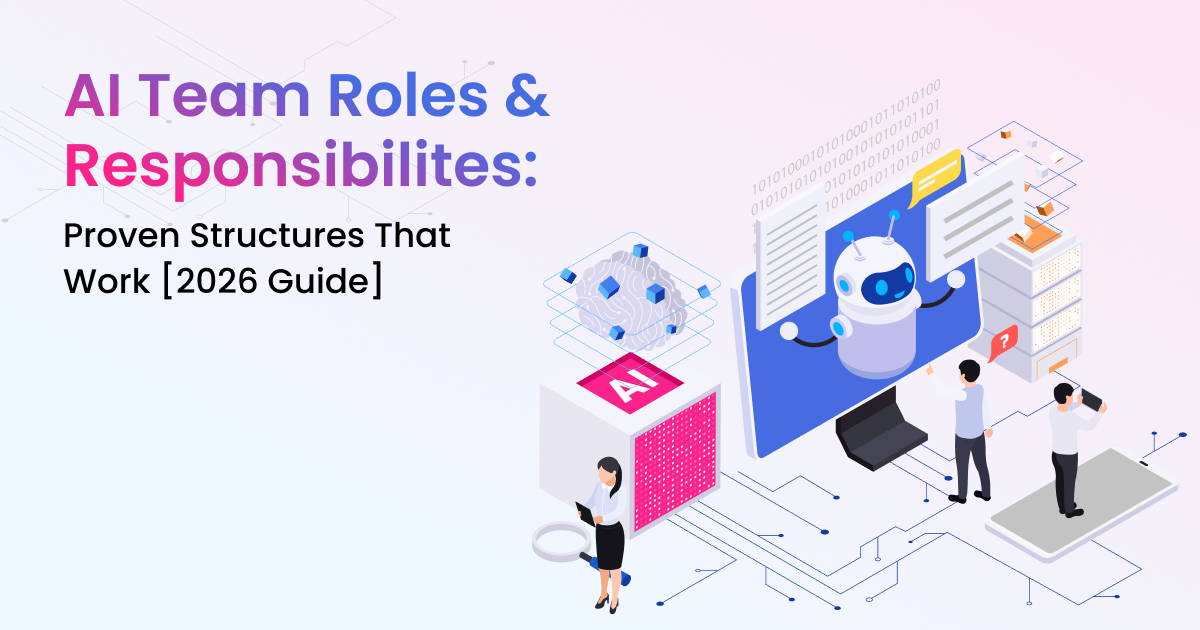
Most organizations want AI, but very few understand what it truly requires. A well-planned AI team structure ensures alignment, smooth workflows, and timely delivery, turning ambitious ideas into scalable, production-ready systems. This guide breaks down the roles, ratios, and frameworks that consistently succeed across startups, mid-sized businesses, and enterprises.

Why 68% of Companies Get AI Team Structure Wrong
Many companies jump into hiring a ML engineers or data scientists expecting instant results, but AI needs orchestration, data infrastructure, and clear ownership to succeed. Ignoring these elements often leads to project delays, broken workflows, and wasted investment. Successful AI teams treat AI not just as code, but as a product, a pipeline, and an evolving system that requires careful planning from day one.
What Are the Core Roles in a Successful AI Team?
No matter the company size, successful AI teams share a common backbone. Each role brings something essential to turn concepts into real-world impact. The following outlines the critical components of a strong AI team structure.
AI/ML Engineers: The Technical Foundation
These engineers implement the models, fine-tune architectures, and build the systems that run the intelligence behind the product. They work closely with data teams to ensure model pipelines perform reliably. They’re also responsible for integrating models into products, optimizing latency, managing model deployments, and handling inference infrastructure. Without them, even the best ideas remain theoretical.
Data Scientists: The Insight Generators
Data scientists interpret data, discover patterns, build prototypes, and validate hypotheses. Their experimentation helps teams decide which direction is worth pursuing. They explore correlations, run statistical analyses, and help define business metrics that matter. Essentially, they turn raw, messy data into clarity and direction, supporting both the product strategy and technical development.
Data Engineers: The Infrastructure Builders
A large portion of AI success depends on healthy data pipelines. Data engineers design, maintain, and optimize the architecture that cleans, curates, and moves data across the ecosystem. They ensure datasets are structured, scalable, and accessible to downstream teams. Without this foundation, ML models risk being inaccurate, brittle, or unusable.
AI Product Managers: The Strategic Leaders
No AI initiative works without a guiding vision. AI Product Managers bridge technical depth with business impact. They define use cases, create roadmaps, align stakeholders, prioritize requirements, and ensure every technical decision maps to real-world value. They are the orchestrators who keep the team aligned with customer needs and long-term goals.
How Many People Do You Need for Different AI Projects?
AI projects scale with complexity, integration needs, and expected impact. Different business scenarios require different team sizes, but the following ranges consistently help organizations plan realistically.
Small AI Implementation (3–5 people)
For small automation tasks or pilot ML models, the essential team usually includes:
- 1 AI/ML Engineer
- 1 Data Scientist
- 1 Data Engineer
- Optional: 1 part-time Product Manager
This setup works for startups or first-time AI adopters where the goal is to validate feasibility without heavy investment.
Medium AI Solution (6–10 people)
When the project involves real-time systems, moderate data volume, or cross-functional integration, the team expands to:
- 2–3 AI/ML Engineers
- 2 Data Scientists
- 2 Data Engineers
- 1 Product Manager
This size supports iterative development and smoother collaboration between experimentation and deployment.
Enterprise AI Platform (10+ people)
Large companies need robust AI platforms with full-stack capabilities:
- 5+ AI/ML Engineers
- 4+ Data Scientists
- 3–4 Data Engineers
- 1–2 AI Product Managers
- Additional supporting roles (DevOps, QA, UX, Analysts)
This scale is ideal for multiple models, continuous updates, compliance requirements, and high uptime expectations.
What Ratios Work Best for AI Teams?
Balanced ratios allow faster iteration, smoother deployments, and healthier collaboration. The ratios below are tested across hundreds of real-world implementations.
Engineers vs Scientists Ratio
Teams function best when there are more engineers than scientists. A common structure is:
- 2 AI/ML Engineers for every 1 Data Scientist
Data scientists generate hypotheses and prototypes; engineers produce them. If the ratio flips, ideas pile up, but nothing reaches production.
Senior vs Junior Balance
Too many senior members lead to heavy decision cycles, while too many juniors slow down technical execution. A strong AI team typically uses a 60:40 or 70:30 senior-to-junior balance. Seniors guide architecture and quality; juniors handle repetitive tasks and learn through hands-on work.
Specialists vs Generalists Mix
Generalists help with agility. Specialists bring depth in fields like NLP, vision, or time-series. Successful teams maintain:
- 70% generalists
- 30% specialists
This blend ensures versatility without sacrificing expertise for complex problems.
How Do You Scale AI Teams Effectively?
Scaling an AI initiative works best when the team grows in clear phases instead of scattered hiring. Each stage has its own purpose, skill needs, and maturity level.
Phase 1: Proof of Concept Team
The goal here is simple validation. Teams stay very small and flexible, usually with one engineer, one data scientist, and a product manager in a guiding direction. Their job is to confirm that the model can solve a real business problem and that the data is strong enough to support it. Speed, experimentation, and quick learning matter more than structure at this point.
Phase 2: MVP Development Team
Once feasibility is proven, the team moves toward creating a usable version. More engineers join to support model integration, pipelines start becoming more stable, and product requirements become sharper. The focus shifts from “can this work” to “can this work for real users.” Collaboration tightens between engineering and product, so the solution is both functional and aligned with business goals.
Phase 3: Production-Ready Team
In this stage, reliability becomes a priority. Dedicated data engineers, AI or ML engineers, and QA specialists form a stronger technical backbone. Deployment workflows become standardized, and MLOps practices are put in place to manage versions, monitor performance, and ensure smooth handoffs. The aim is to build something that can run safely in real business environments.
Phase 4: Scaling and Optimization Team
When scaling begins, the work expands beyond development. Teams now include MLOps engineers, monitoring specialists, model evaluators, and multiple product owners. Governance, retraining cycles, compliance, and long-term monitoring have become the focus. The priority shifts toward stability, performance at scale, and continuous improvement as the AI system becomes a core part of operations.
What Supporting Roles Do AI Teams Need?
AI teams need more than engineers and scientists. The supporting roles around them play a crucial part in making sure every system runs smoothly, scales properly, and delivers value that users can actually experience. These roles strengthen reliability, usability, and business alignment, turning isolated models into complete AI solutions.
DevOps Engineers for AI and MLOps
MLOps and DevOps engineers help move AI systems from experimentation to real-world performance. They work on deployment automation, continuous integration of workflows, environment management, and monitoring setups. Their work ensures that models run consistently across different stages of development, from training to production. Without their contribution, AI systems remain slow, unstable, or difficult to maintain as they grow in usage and complexity.
Quality Assurance for AI Systems
AI quality assurance goes beyond simple functionality tests. QA teams validate data quality, check for unintended behavior, run edge case scenarios, and evaluate the system’s performance under stress. Their work helps identify issues early, before they affect users or cause system failures. This makes the overall AI pipeline more trustworthy and reduces the risk of deploying unreliable outputs in live environments.
Business Analysts for Requirements
Business analysts help connect technical teams with real business needs. They refine use cases, define measurable KPIs, and translate high-level goals into concrete requirements. This role ensures that AI initiatives stay aligned with organizational priorities instead of drifting toward unnecessary complexity or features that do not contribute to outcomes. With clear guidance, AI teams can build solutions that solve the right problems.
UI and UX Designers for AI Applications
AI outputs can be complex, and users often struggle to interpret raw predictions or recommendations. UI and UX designers help bridge this gap by creating interfaces that are clear, interactive, and meaningful. Their work makes AI insights more intuitive, improves adoption, and enhances the overall product experience. When AI solutions are easy to understand and navigate, teams can achieve higher user engagement and better long-term impact.
Should You Hire Full-Time or Contract AI Teams?
Both models work depending on goals, budget, and time-to-market. Contract teams move fast and reduce costs, while full-time teams offer stability, deeper product knowledge, and long-term ownership. Most organizations use a blended approach, combining contractors for specialized tasks and full-time staff for ongoing system evolution. The choice depends on AI roadmap maturity, system complexity, and desired internal capability development.

Conclusion
Building an effective AI team structure isn’t about hiring the biggest team or chasing every trending role. It’s about creating the right mix of specialists, strategic leaders, and supporting functions who can turn ideas into a scalable impact. Whether you’re starting with a small proof-of-concept or moving toward an enterprise-level AI platform, clarity in AI team roles, thoughtful ratios, and phased scaling make all the difference. Organizations that approach AI with a structured, capability-first mindset unlock sustainable success, reduce risk, and accelerate real business outcomes.
Frequently Asked Questions
Author
Ravikumar Sreedharan

CEO & Co-Founder, Expertshub.ai
Ravikumar Sreedharan is the Co-Founder of ExpertsHub.ai, where he is building a global platform that uses advanced AI to connect businesses with top-tier AI consultants through smart matching, instant interviews, and seamless collaboration. Also the CEO of LedgeSure Consulting, he brings deep expertise in digital transformation, data, analytics, AI solutions, and cloud technologies. A graduate of NIT Calicut, Ravi combines his strategic vision and hands-on SaaS experience to help organizations accelerate their AI journeys and scale with confidence.
Latest Post
AI Talent Matching: How AI is Transforming Talent Acquisition in 2026

Upwork Alternatives: Best Platforms to Hire and Find Work in 2026