Ethical Hacking and AI: The New Frontier in Security Testing

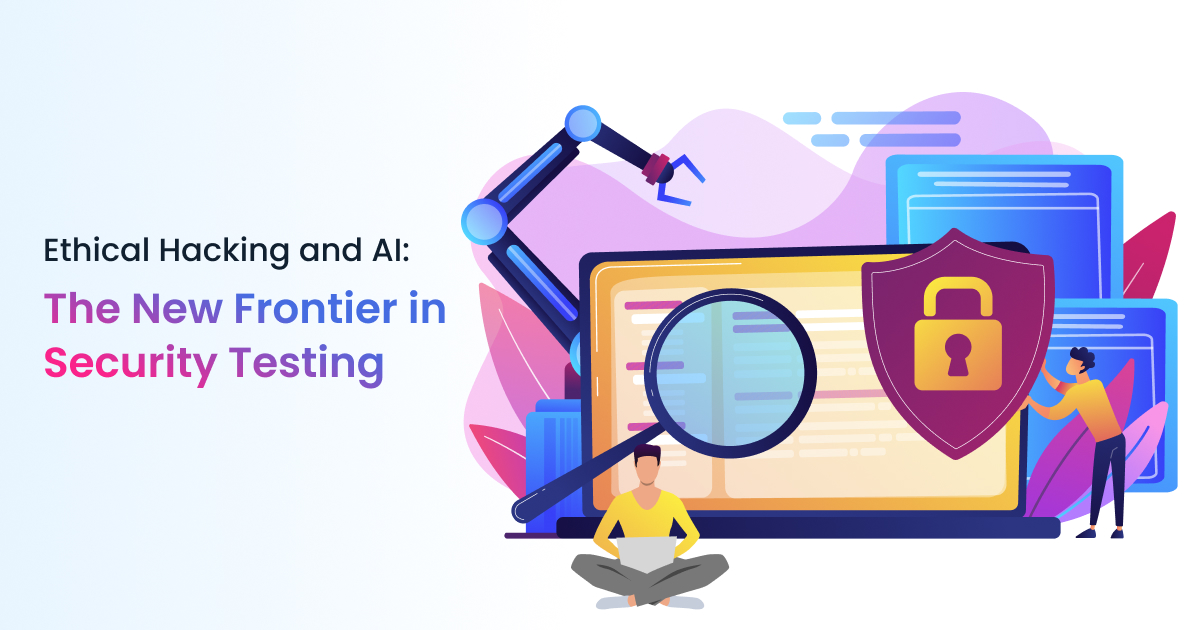
Ethical hacking has always evolved alongside technology. As systems became more complex, so did attack methods. Today, artificial intelligence is accelerating that evolution. The convergence of ethical hacking and AI is reshaping how security testing is performed, moving it from largely manual, time-bound exercises to continuous, adaptive, and intelligent processes.
For organizations facing increasingly automated and sophisticated cyber threats, AI is no longer just a defensive tool. It is becoming a core capability in offensive security, helping teams think and act more like real attackers.

Traditional penetration testing relies heavily on human expertise, predefined scripts, and limited testing windows. While this approach remains valuable, it struggles to keep pace with modern attack surfaces that include cloud infrastructure, APIs, AI models, and constantly changing applications.
AI addresses these gaps by enabling:
As attackers increasingly use automation and AI themselves, ethical hackers must adopt similar capabilities to stay effective.
AI for penetration testing does not replace ethical hackers. Instead, it augments their capabilities.
AI-driven systems can analyse vast amounts of data from networks, applications, logs, and configurations to identify patterns that indicate weaknesses. These systems learn over time, improving their ability to detect subtle vulnerabilities that might be missed during manual testing.
Key improvements include:
This allows human testers to focus on complex logic flaws, business impact, and creative attack paths.
One of the most significant developments is AI-powered red teaming. Red teams simulate real-world attacks to test an organization’s detection and response capabilities. Traditionally, this requires extensive planning, manpower, and time.
AI enhances red teaming by:
AI-powered red teams can model how attackers pivot within systems, escalate privileges, or evade detection, providing a more realistic assessment of security posture.
MITRE’s ATT&CK and ATLAS frameworks are increasingly used alongside AI to map adversarial techniques against both traditional systems and AI models.
Automated pentest tools powered by AI are gaining adoption across enterprises and security teams. Unlike older automated scanners, these tools aim to replicate attacker logic rather than simply check for known vulnerabilities.
Capabilities often include:
These tools are especially valuable for large organizations where manual testing alone cannot cover the full attack surface.
However, they are most effective when used alongside human expertise. AI tools surface and prioritize issues, while ethical hackers validate impact and business risk.
Bug bounty programs rely on external researchers to find vulnerabilities. As competition increases and attack surfaces expand, AI is beginning to influence how these programs operate.
AI in bug bounty programs is being used to:
Some ethical hackers now use AI tools to analyse applications, generate test cases, or identify hidden attack paths, increasing efficiency and effectiveness.
Platforms running bug bounty programs are also using AI to reduce noise and focus rewards on high-impact findings.
One of the most promising areas is AI for vulnerability discovery, especially in complex codebases and systems.
AI models can:
In some cases, AI has been shown to uncover vulnerabilities that were previously unknown or difficult to detect using traditional static or dynamic analysis alone
This is particularly relevant as software becomes more modular and dependent on third-party components.
AI is now being actively explored across multiple offensive security use cases, including:
In the context of AI systems themselves, ethical hackers are also testing for:
This expands ethical hacking beyond traditional infrastructure into AI-specific threat domains.
The integration of AI into ethical hacking raises the bar for skills. Security professionals now need to understand:
This has created demand for hybrid roles that combine ethical hacking expertise with AI and machine learning knowledge. General-purpose penetration testers may struggle without upskilling in these areas.
According to global cybersecurity workforce studies, skills shortages remain significant, particularly in advanced and emerging security domains
While AI brings power and efficiency, it also introduces risks. Poorly controlled AI tools can:
Responsible use requires governance, human oversight, and ethical boundaries. AI should enhance ethical hacking, not automate it without accountability.
The combination of ethical hacking and AI represents a major shift in how security testing is performed. AI enables faster, smarter, and more realistic offensive security testing, helping organizations uncover weaknesses before attackers do.
From AI-powered red teaming and automated pentesting to vulnerability discovery and bug bounty optimization, AI is redefining offensive security. However, success depends on skilled professionals who understand both domains deeply.
For organizations, investing in AI-enabled ethical hacking is becoming a necessity. For security professionals, learning how to use and secure AI systems opens the door to some of the most impactful and future-ready careers in cybersecurity.

Industries with large, complex, and constantly evolving attack surfaces see the highest ROI:
• Banking & Fintech
• Healthcare
• SaaS & Cloud Platforms
• E-commerce
• Telecom
• Public Sector Systems
Any organization handling sensitive data or operating at scale benefits immediately.
Author

CEO & Co-Founder, Expertshub.ai
Ravikumar Sreedharan is the Co-Founder of ExpertsHub.ai, where he is building a global platform that uses advanced AI to connect businesses with top-tier AI consultants through smart matching, instant interviews, and seamless collaboration. Also the CEO of LedgeSure Consulting, he brings deep expertise in digital transformation, data, analytics, AI solutions, and cloud technologies. A graduate of NIT Calicut, Ravi combines his strategic vision and hands-on SaaS experience to help organizations accelerate their AI journeys and scale with confidence.