Where to Hire Generative AI Developers for RAG, LLM, and Automation Projects

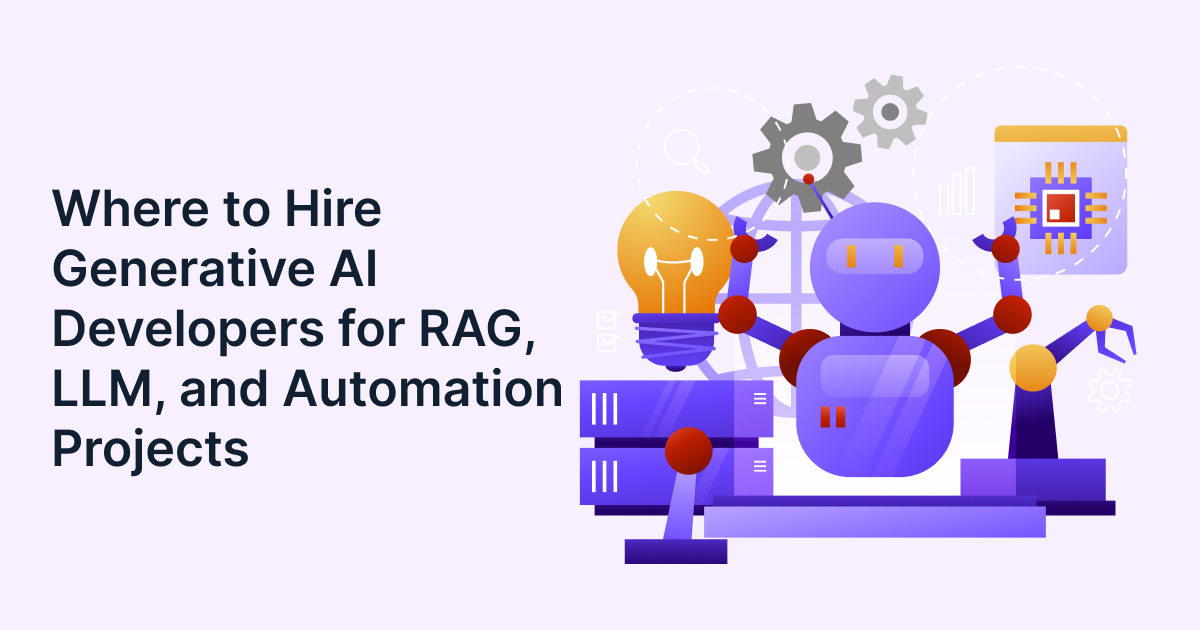
Generative AI has moved quickly from experimentation to real-world deployment. Businesses are now using large language models for search, support, internal knowledge systems, and automation. As use cases become more complex, the need to hire generative AI developers with hands-on experience in RAG, LLMs, and workflow automation has become critical.
The challenge is not a lack of talent, but knowing where to find developers who understand production-grade GenAI systems. This guide explains where to hire generative AI developers, what skills matter most, how much projects typically cost, and how to decide between freelancers and teams.

You can hire generative AI developers through several channels, but not all are equally effective. General freelance platforms provide access to many profiles, but often require heavy screening to identify true GenAI expertise. Many developers list LLM experience without having built real systems beyond simple demos.
Specialized AI talent platforms are increasingly preferred for GenAI hiring. These platforms focus on LLM engineers, RAG developers, and AI automation experts who have experience working with real datasets, production constraints, and enterprise environments. This reduces hiring time and lowers the risk of mismatched skills.
Another option is hiring through AI consulting networks or referrals. Developers recommended by trusted peers or communities often bring stronger problem-solving ability and better collaboration. Regardless of the channel, the key is to validate hands-on experience with real deployments rather than theoretical knowledge.
Strong generative AI developers combine model knowledge with system-level thinking. Beyond understanding how LLMs work, they know how to integrate models into applications that are reliable, secure, and scalable.
Core skills include prompt engineering, fine-tuning strategies, and experience with retrieval augmented generation pipelines. RAG developers should understand document ingestion, embedding strategies, chunking methods, and relevance optimization. Familiarity with vector databases and search tuning is also essential.
Equally important are software engineering skills. GenAI developers should be comfortable building APIs, handling authentication, managing latency, and deploying systems in cloud environments. Developers who can bridge AI and backend engineering tend to deliver far more reliable outcomes.
Dive Deeper → Skill Spotlight: What Makes a Great Generative AI Expert?
The cost of a generative AI project depends on scope, complexity, and deployment requirements. Simple prototypes or internal tools usually cost far less than production systems that require security, monitoring, and scalability.
Projects involving RAG pipelines, custom automation workflows, or multi-model orchestration typically require more time and expertise. Costs also increase when projects involve proprietary data, compliance requirements, or ongoing optimization.
In practice, many companies choose milestone-based pricing to manage risk and budget more effectively. Instead of focusing only on upfront cost, it is important to evaluate long-term value, including performance stability, maintenance effort, and adaptability as models evolve.
Hiring a freelance GenAI developer works well for focused tasks, proof-of-concepts, or clearly defined automation projects. Freelancers offer flexibility, faster onboarding, and access to niche expertise.
AI development teams are better suited for large-scale systems, enterprise integrations, or projects with tight timelines and multiple dependencies. Teams bring structured processes, shared accountability, and broader skill coverage across AI, backend, and DevOps.
Many organizations use a hybrid approach. They hire freelance LLM engineers or RAG developers for specialized components while relying on an internal or external team for overall system integration and long-term ownership.
Yes, many GenAI developers specialize in building custom automation workflows. These workflows often combine LLMs with business logic, APIs, and existing tools to automate tasks such as document processing, customer support, reporting, and internal knowledge retrieval.

Effective AI automation experts focus on reliability and control, not just intelligence. They design workflows with validation layers, fallback mechanisms, and human-in-the-loop options to ensure consistent performance.
Custom automation becomes especially powerful when GenAI systems are tightly integrated with internal data sources and operational tools rather than operating as standalone chat interfaces.
Author

CEO & Co-Founder, Expertshub.ai
Ravikumar Sreedharan is the Co-Founder of ExpertsHub.ai, where he is building a global platform that uses advanced AI to connect businesses with top-tier AI consultants through smart matching, instant interviews, and seamless collaboration. Also the CEO of LedgeSure Consulting, he brings deep expertise in digital transformation, data, analytics, AI solutions, and cloud technologies. A graduate of NIT Calicut, Ravi combines his strategic vision and hands-on SaaS experience to help organizations accelerate their AI journeys and scale with confidence.