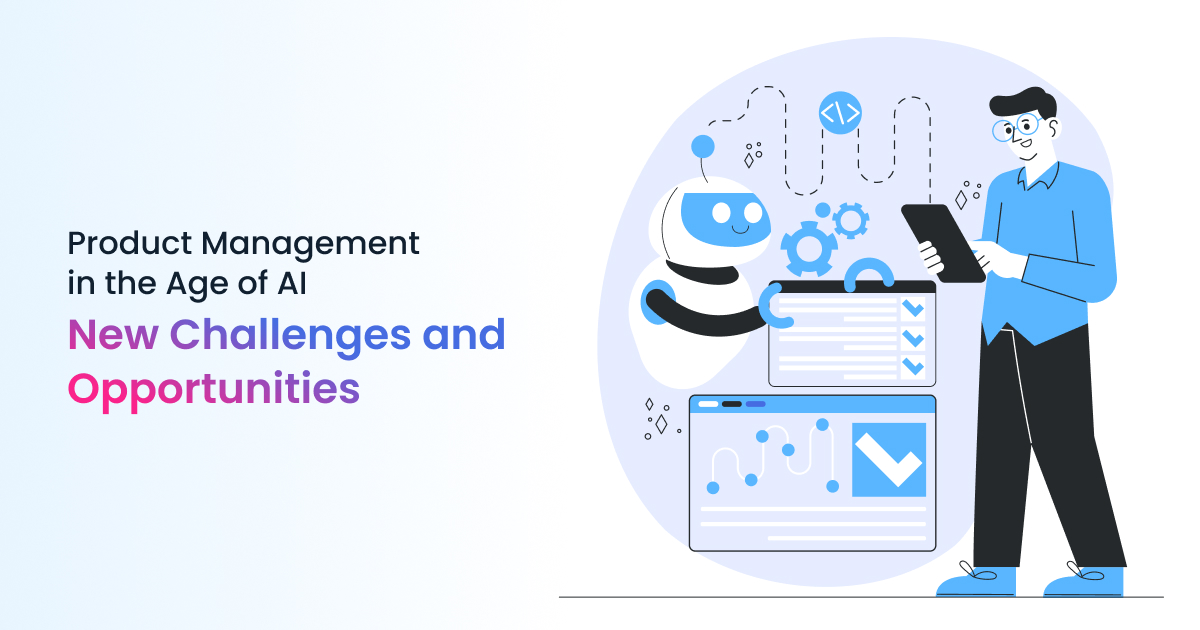
Product Management in the Age of AI: New Challenges and Opportunities

Artificial intelligence is changing not only how products are built, but also how they are imagined, validated, and scaled. As AI becomes embedded into software, platforms, and services, product management itself is evolving. Traditional product frameworks still matter, but they are no longer sufficient on their own.
This shift has given rise to AI product management, a discipline that blends classic product thinking with data science, machine learning, and ethical decision-making. For product leaders, this creates both new challenges and powerful opportunities.

Traditional product management focuses on defining user problems, prioritizing features, coordinating with engineering, and driving adoption. AI-powered products add layers of complexity that change how these activities are executed.
AI systems:
This means product managers can no longer treat features as static or outcomes as fully predictable. Managing AI products requires continuous learning, monitoring, and iteration.
The AI product manager role has emerged to bridge the gap between business goals, user needs, and AI capabilities. An AI PM is not expected to build models, but they must understand how AI systems work well enough to make informed product decisions.
A PM for AI products typically works on:
This role sits at the intersection of strategy, technology, and ethics.
While the core product mindset remains the same, there are important differences between an AI PM vs traditional PM.
Outcome predictability
Traditional products usually behave consistently once shipped. AI products may change behavior as models learn or data shifts, requiring ongoing oversight.
Data as a dependency
For AI products, data is not just an input but a core product asset. AI PMs must think about data sourcing, quality, labeling, and governance as part of the roadmap.
Experimentation over certainty
AI product development is more experimental. Product managers must be comfortable with iteration, uncertainty, and gradual performance improvement rather than fixed delivery guarantees.
Ethical and regulatory considerations
Bias, fairness, explainability, and compliance are product-level concerns in AI, not just technical ones.
AI product managers face challenges that rarely appear in traditional PM roles.
Defining the right problem
Not every problem needs AI. One of the biggest risks is forcing AI into use cases where simpler solutions would work better.
Managing stakeholder expectations
AI capabilities are often misunderstood. Product managers must set realistic expectations about accuracy, limitations, and timelines.
Balancing accuracy and user experience
Improving model accuracy can sometimes slow performance or reduce explainability. AI PMs must balance technical metrics with user trust and usability.
Handling data risks
Data privacy, consent, and security are ongoing concerns, especially when products handle sensitive information.
Despite the challenges, AI unlocks significant opportunities for product innovation.
Personalization at scale
AI enables products to adapt to individual users in ways that were not feasible before, improving engagement and retention.
Continuous improvement
AI products can improve after launch as models learn from new data, extending product value over time.
New product categories
AI has enabled entirely new categories such as intelligent assistants, predictive platforms, and autonomous systems.
Smarter decision-making
AI-driven insights can inform product strategy, helping teams prioritize features based on real usage patterns and predicted outcomes.
This is where AI-driven product strategy becomes a competitive advantage.
The skills for AI product managers go beyond classic PM competencies.
Key skill areas include:
AI PMs do not need to code models, but they must ask the right questions and understand trade-offs.
An effective AI product strategy starts with value, not technology.
Successful AI PMs focus on:
AI should serve the product vision, not dictate it.
Demand for product managers with AI experience is growing across industries, including SaaS, healthcare, finance, and enterprise platforms. As more companies move from experimentation to production AI, the need for skilled AI PMs will continue to rise.
For traditional product managers, upskilling in AI concepts and data-driven thinking can open new career paths. For new entrants, AI product management offers a chance to work on some of the most impactful and complex products being built today.

Product management in the age of AI is more challenging, but also more rewarding. AI changes how products behave, how value is delivered, and how success is measured. This requires product managers to expand their skill sets and rethink traditional approaches.
The AI product manager is becoming a critical role in modern organizations, guiding teams through uncertainty while unlocking new opportunities for innovation. Those who can combine strong product instincts with AI literacy and ethical awareness will be best positioned to lead in this new era.
Author

CEO & Co-Founder, Expertshub.ai
Ravikumar Sreedharan is the Co-Founder of ExpertsHub.ai, where he is building a global platform that uses advanced AI to connect businesses with top-tier AI consultants through smart matching, instant interviews, and seamless collaboration. Also the CEO of LedgeSure Consulting, he brings deep expertise in digital transformation, data, analytics, AI solutions, and cloud technologies. A graduate of NIT Calicut, Ravi combines his strategic vision and hands-on SaaS experience to help organizations accelerate their AI journeys and scale with confidence.