Building a Remote Machine Learning Team: Challenges and Solutions

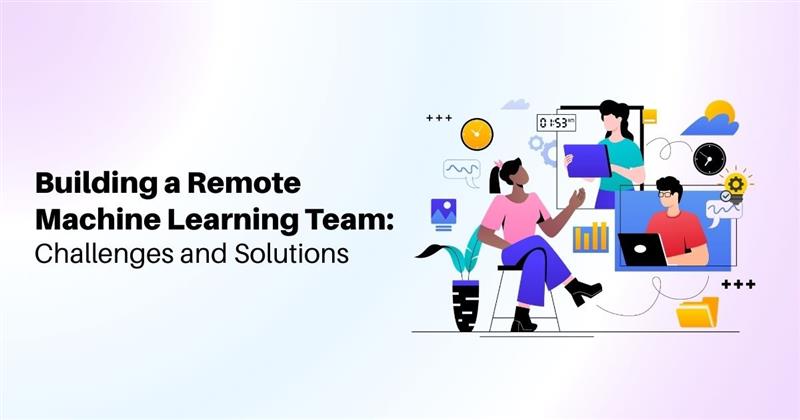
A remote machine learning team allows organizations to access global AI talent, reduce hiring bottlenecks, and scale faster without geographic constraints. As AI adoption accelerates, companies are increasingly turning to distributed ML development models to stay competitive.
The shift toward remote and hybrid work has reshaped technical hiring. According to McKinsey’s American Opportunity Survey, a significant portion of the workforce now has the option to work remotely at least part of the time.
For machine learning roles, where digital collaboration is already embedded in workflows, remote structures are not just feasible. They are often advantageous.
However, building a high-performing remote machine learning team requires more than hiring talent in different locations. It demands intentional structure, governance, and infrastructure.
A remote machine learning team faces technical and organizational challenges that traditional software teams may not encounter.
Machine learning projects often involve sensitive datasets, including customer information, financial records, or healthcare data. When teams operate across regions, enforcing consistent data security standards becomes more complex.
Secure access controls, encrypted storage, strict role-based permissions, and clear compliance documentation are essential. Artificial intelligence governance frameworks must extend to remote workflows to ensure regulatory alignment.
Organizations that fail to define clear access protocols risk exposure and compliance violations.
Distributed ML development often depends on heavy compute resources such as GPUs and cloud-based clusters. Without centralized infrastructure planning, teams may duplicate environments or overspend on compute.
A structured resource allocation strategy is necessary. Centralized cloud accounts with usage monitoring and cost dashboards help maintain visibility and control.
Model development is iterative and experimental. Remote collaboration can slow iteration cycles if documentation is inconsistent or communication channels are unclear.
Version control discipline, shared experiment tracking tools, and structured sprint planning are critical for virtual data science teams. Clear ownership prevents overlapping work.
Deployment becomes more complex in distributed environments. Remote teams must coordinate infrastructure changes, monitor model drift, and handle incident responses across time zones.
Defined deployment protocols and monitoring dashboards ensure operational continuity.
The structure of a remote machine learning team determines how effectively it executes.
In centralized models, leadership defines strategy, tooling standards, and governance from a core team while remote engineers execute tasks. This approach ensures consistency but may slow localized innovation.
Distributed leadership allows regional leads to manage execution independently. While this increases agility, it requires strong communication frameworks to prevent fragmentation.
Many successful organizations adopt a hybrid model, where governance is centralized but execution remains distributed.
Machine learning does not operate in isolation. Remote ML teams must integrate with product, engineering, compliance, and business stakeholders.
Cross-functional rituals such as structured sprint reviews, roadmap alignment sessions, and KPI tracking keep distributed ML development aligned with strategic goals.
Clear reporting structures prevent confusion. Define technical ownership, review cycles, and escalation pathways.
Accountability should be outcome-based. Measure deployment frequency, model performance, and business impact rather than hours logged.

A remote machine learning team depends on robust infrastructure.
Version control platforms ensure reproducibility. Experiment tracking tools allow distributed teams to compare results transparently. Cloud-based training environments provide scalable compute access. Monitoring systems track inference performance and model drift in production.
Collaboration tools such as structured documentation platforms and project management systems reduce miscommunication. Asynchronous communication is particularly important when teams operate across time zones.
Strong infrastructure reduces friction and increases trust within virtual data science teams.
Hiring for a remote machine learning team requires evaluating both technical depth and remote readiness.
Candidates must demonstrate experience with distributed collaboration, documentation discipline, and independent execution. Beyond model-building skills, look for ownership mindset and communication clarity.
Retention depends on structured growth pathways, clear performance metrics, and inclusive culture. Remote professionals value transparency and measurable impact.
Platforms like expertshub.ai support organizations in defining AI hiring needs clearly, conducting AI-driven assessments, and accessing global ML talent aligned with industry requirements. This reduces sourcing friction and improves match quality for distributed ML development.

Organizations that succeed with remote machine learning teams share predictable traits.
Companies that treat remote ML as a structured operating model rather than a temporary workaround often scale more sustainably.
Author

CEO & Co-Founder, Expertshub.ai
Ravikumar Sreedharan is the Co-Founder of ExpertsHub.ai, where he is building a global platform that uses advanced AI to connect businesses with top-tier AI consultants through smart matching, instant interviews, and seamless collaboration. Also the CEO of LedgeSure Consulting, he brings deep expertise in digital transformation, data, analytics, AI solutions, and cloud technologies. A graduate of NIT Calicut, Ravi combines his strategic vision and hands-on SaaS experience to help organizations accelerate their AI journeys and scale with confidence.